Can my PC run it?
Get a verdict for your hardware for this game
Looking at Going Medieval, an Indie, RPG and Simulation title from Foxy Voxel. We work through the official specs, estimate frame rates on 28 graphics cards, size up the VRAM and processor needs and suggest settings and laptop options.

Where it lands among 937 modelled titles, and how that plays out for entry, mid-range and high-end cards.
Across the 937 games we have modelled, Going Medieval lands on a demand score of 23, ahead of 68% of them. In plain terms it is a mid-weight game for graphics hardware.
The score is derived from the recommended graphics card in the publisher requirements, GTX 1660 Super / RTX 2060 or RX 6600 XT, scaled to a 1080p High equivalent. It is a modelling choice rather than a measurement, so read it as a ranking more than a promise.
Processor demand is rated separately: Going Medieval scores 34 on our CPU scale, higher than 83% of the games we model.
Everything Steam lists for Going Medieval, then what it means for real hardware.
These are the developer figures on Steam, and patches can change them.
Steam names GTX 1050 Ti (4 GB) or RX 580 (4 GB) as the minimum GPU. Expect around 51 FPS at 1080p Low, or roughly 28 FPS if you raise the preset to High.
Steam suggests GTX 1660 Super / RTX 2060 or RX 6600 XT as the recommended card, good for roughly 80 FPS at 1080p and 52 FPS at 1440p on High here. That is above 60 FPS at 1080p, so the recommended spec reads as a comfortable 1080p target.
For the processor, Steam lists Intel Core i5-10600K / i7-10700. In our model a chip in that class can prepare roughly 100 FPS in this game, so it will not hold back most mid-range cards.
You will need 8 GB RAM of RAM at minimum or 16 GB RAM to match the recommended spec, plus 2 GB available space on your drive.
From a 30 FPS floor to 4K, here is the card each target asks for in Going Medieval.
| Target | Lowest card tested | First RTX 50 card | Also reaches it |
|---|---|---|---|
| Playable, 30 FPS at 1080p Low | GTX 1060 6GB | RTX 5050 | GTX 1660 Super, RTX 2060, RX 6600 |
| 1080p 60 FPS, Medium | GTX 1060 6GB | RTX 5050 | GTX 1660 Super, RTX 2060, RX 6600 |
| 1080p 60 FPS, High | GTX 1660 Super | RTX 5050 | RTX 2060, RX 6600, RTX 3060 12GB |
| 1440p 60 FPS, High | RTX 2060 | RTX 5050 | RX 6600, RTX 3060 12GB, RX 7600 |
| 1440p 100 FPS, High | RTX 5060 | RTX 5060 | RTX 4060 Ti 8GB, RTX 3070, RTX 5060 Ti 16GB |
| 4K 60 FPS, High with upscaling | RTX 3060 12GB | RTX 5050 | RX 7600, RTX 5050, RTX 4060 |
| 4K 60 FPS, Ultra with upscaling | Arc B580 | RTX 5060 | RTX 5060, RTX 4060 Ti 8GB, RTX 3070 |
For 1080p at 60 FPS on High, GTX 1660 Super is the entry point in our list, with RTX 5050 the first RTX 50 card that clears it.
For a smooth 1440p on High you want at least the RTX 2060. Within the RTX 50 range that means the RTX 5050 or above.
For 4K, upscaling does most of the work: with Quality DLSS, FSR or XeSS-style upscaling the RTX 5050 is the first RTX 50 card to achieve 60 FPS on High.
The table covers NVIDIA, AMD and Intel cards. Add your own processor, memory and settings in the can my PC run it checker and check for a processor limit in the bottleneck checker.
Estimated frame rates for 28 graphics cards from NVIDIA, AMD and Intel. Use the buttons to change resolution.
The fastest card here, the RTX 5090, returns around 238 FPS at 1440p and 226 FPS at 4K. The RTX 5050 sits at roughly 79 FPS at 1440p, which shows how wide the range is in Going Medieval.
| Graphics card | 1080p | 1440p | 4K | 1440p upscaled | 4K upscaled |
|---|---|---|---|---|---|
| RTX 5090 32 GB | 238 | 238 | 226 | 238 | 238 |
| RTX 4090 24 GB | 238 | 238 | 174 | 238 | 238 |
| RTX 5080 16 GB | 238 | 238 | 143 | 238 | 214 |
| RX 7900 XTX 24 GB | 238 | 238 | 139 | 238 | 209 |
| RTX 4080 Super 16 GB | 238 | 233 | 134 | 238 | 201 |
| RTX 5070 Ti 16 GB | 238 | 212 | 122 | 238 | 183 |
| RX 9070 XT 16 GB | 238 | 212 | 122 | 238 | 183 |
| RTX 4070 Ti Super 16 GB | 238 | 200 | 115 | 238 | 172 |
| RX 9070 16 GB | 238 | 188 | 108 | 238 | 162 |
| RTX 5070 12 GB | 238 | 182 | 104 | 238 | 157 |
| RTX 4070 Super 12 GB | 238 | 173 | 99 | 238 | 149 |
| RX 7800 XT 16 GB | 238 | 167 | 96 | 238 | 143 |
| RTX 3080 10GB 10 GB | 235 | 151 | 87 | 227 | 130 |
| RTX 4070 12 GB | 225 | 145 | 83 | 218 | 125 |
| RX 7700 XT 12 GB | 216 | 139 | 80 | 209 | 120 |
| RTX 5060 Ti 16GB 16 GB | 197 | 127 | 73 | 191 | 110 |
| RTX 3070 8 GB | 178 | 115 | 66 | 173 | 99 |
| RTX 4060 Ti 8GB 8 GB | 169 | 109 | 63 | 164 | 94 |
| RTX 5060 8 GB | 164 | 106 | 61 | 159 | 91 |
| Arc B580 12 GB | 155 | 100 | 57 | 150 | 86 |
| RTX 4060 8 GB | 141 | 91 | 52 | 136 | 78 |
| RTX 5050 8 GB | 122 | 79 | 45 | 118 | 68 |
| RX 7600 8 GB | 122 | 79 | 45 | 118 | 68 |
| RTX 3060 12GB 12 GB | 113 | 73 | 42 | 109 | 63 |
| RX 6600 8 GB | 103 | 67 | 38 | 100 | 57 |
| RTX 2060 6 GB | 94 | 61 | 26 | 91 | 43 |
| GTX 1660 Super 6 GB | 80 | 52 | 22 | 77 | 36 |
| GTX 1060 6GB 6 GB | 52 | 33 | 15 | 50 | 24 |
These estimates use High settings paired with a quick CPU. The two upscaled columns switch on Quality DLSS, FSR or XeSS-style upscaling, which only applies if the game supports it. Figures above 360 FPS are shown as 360+. For a head-to-head, open the GPU comparison tool.
Twelve popular cards, with a plain-English verdict for each.
| Graphics card | 1080p | 1440p | 4K | Verdict |
|---|---|---|---|---|
| GTX 1060 6GB | 52 | 33 | 15 | Around 52 FPS at 1080p on High, so lower a few settings for 60 FPS. |
| RTX 2060 | 94 | 61 | 26 | Handles 1440p at about 61 FPS, with 4K out of reach natively (26 FPS). |
| RTX 3060 12GB | 113 | 73 | 42 | Needs upscaling for 4K: about 63 FPS with Quality upscaling, 42 FPS without. |
| RTX 4060 | 141 | 91 | 52 | Treat 4K as an upscaling job: 52 FPS native, 78 FPS upscaled. |
| RTX 5060 | 164 | 106 | 61 | Reaches 61 FPS at 4K on High, so native 4K is realistic. |
| RTX 5060 Ti 16GB | 197 | 127 | 73 | Reaches 73 FPS at 4K on High, so native 4K is realistic. |
| RTX 5070 | 238 | 182 | 104 | Native 4K works here at about 104 FPS, with no upscaling needed. |
| RX 7800 XT | 238 | 167 | 96 | Native 4K works here at about 96 FPS, with no upscaling needed. |
| RTX 5070 Ti | 238 | 212 | 122 | Reaches 122 FPS at 4K on High, so native 4K is realistic. |
| RTX 5080 | 238 | 238 | 143 | Comfortable at 4K on High, around 143 FPS before any upscaling. |
| RTX 4090 | 238 | 238 | 174 | Reaches 174 FPS at 4K on High, so native 4K is realistic. |
| RTX 5090 | 238 | 238 | 226 | Comfortable at 4K on High, around 226 FPS before any upscaling. |
Each verdict compares the card with a 60 FPS target on High settings. Where a card falls short, the usual fix is a lower preset or upscaling, which the settings section prices in.
Between the RTX 5060 (106 FPS at 1440p) and the RTX 5070 (182 FPS) there is roughly a 71% difference in Going Medieval.
One plan per resolution, each aimed at a steady 60 FPS in this game.
At 1080p, GTX 1660 Super, RTX 3060 12GB, RTX 4060 hold 60 FPS natively on High in our modelling, so you can leave upscaling off and spend the headroom on settings.
Each row below is the best-looking combination that still holds 60 FPS at 1080p in our modelling.
| Card | Best preset | Upscaling | Est. FPS |
|---|---|---|---|
| GTX 1660 Super | Ultra | Native | 61 |
| RTX 3060 12GB | Ultra | Native | 87 |
| RTX 4060 | Ultra | Native | 108 |
| RTX 5060 | Ultra | Native | 126 |
1440p is straightforward on RTX 4060, RTX 5060, RTX 5070, which hold 60 FPS on High natively here, so you only need DLSS, FSR or XeSS-style upscaling for extra smoothness.
Each row below is the best-looking combination that still holds 60 FPS at 1440p in our modelling.
| Card | Best preset | Upscaling | Est. FPS |
|---|---|---|---|
| RTX 4060 | Ultra | Native | 70 |
| RTX 5060 | Ultra | Native | 82 |
| RTX 5070 | Ultra | Native | 140 |
| RTX 5070 Ti | Ultra | Native | 163 |
Native 4K works on RTX 5070 Ti, RTX 4080 Super, RTX 5080, all above 60 FPS on High in our modelling. Upscaling then becomes optional rather than required.
Each row below is the best-looking combination that still holds 60 FPS at 4K in our modelling.
| Card | Best preset | Upscaling | Est. FPS |
|---|---|---|---|
| RTX 5070 Ti | Ultra | Native | 94 |
| RTX 4080 Super | Ultra | Native | 103 |
| RTX 5080 | Ultra | Native | 110 |
| RTX 5090 | Ultra | Native | 174 |
The gain from each rung of the RTX 50 ladder at 1440p on High settings.
| Step | Before (1440p FPS) | After (1440p FPS) | Gain |
|---|---|---|---|
| RTX 5050 to RTX 5060 | 79 | 106 | +35% |
| RTX 5060 to RTX 5060 Ti 16GB | 106 | 127 | +20% |
| RTX 5060 Ti 16GB to RTX 5070 | 127 | 182 | +43% |
| RTX 5070 to RTX 5070 Ti | 182 | 212 | +17% |
| RTX 5070 Ti to RTX 5080 | 212 | 238 | +12% |
| RTX 5080 to RTX 5090 | 238 | 238 | +0% |
Moving from the RTX 5060 Ti 16GB to the RTX 5070 adds roughly 43% at 1440p, the largest jump in the RTX 50 range for Going Medieval. The RTX 5080 to RTX 5090 step adds only close to 0%.
Prices usually climb faster than performance across the range. In Going Medieval that means the best value often sits in the middle rather than at the top.
Compare options directly in the upgrade value calculator or the GPU price to performance calculator.
What the game is likely to want from graphics memory on High. Running short causes stutter even on a fast GPU.
| Your VRAM | 1080p Low | 1080p High | 1440p High | 4K High |
|---|---|---|---|---|
| 6 GB | Fine | Fine | Tight | Not enough |
| 8 GB | Fine | Fine | Fine | Tight |
| 12 GB | Fine | Fine | Fine | Fine |
| 16 GB | Fine | Fine | Fine | Fine |
| 24 GB | Fine | Fine | Fine | Fine |
We put Going Medieval at roughly 4 GB at 1080p High, 5.2 GB at 1440p and 7.2 GB at 4K. That is an estimate derived from the recommended GPU, so treat it as a guide and leave some memory spare.
A single step down in textures, to Medium, reduces the 1440p estimate to roughly 4.4 GB, which is often enough to avoid stutter.
Test other settings in the VRAM calculator and our guide on how much VRAM you need for gaming.
Which processors keep a fast graphics card busy in this game.
| Processor | Max FPS it can feed | Good for 100+ FPS? |
|---|---|---|
| Ryzen 7 9800X3D | 274 | Yes |
| Ryzen 7 7800X3D | 238 | Yes |
| Core i7-14700K | 205 | Yes |
| Core i5-14600K | 186 | Yes |
| Ryzen 5 7600 | 176 | Yes |
| Ryzen 5 5600 | 138 | Yes |
| Core i5-12400F | 131 | Yes |
| Ryzen 5 3600 | 100 | Yes |
| Core i3-12100F | 100 | Yes |
Steam lists Intel Core i5-9400F as the minimum processor and Intel Core i5-10600K / i7-10700 as the recommended one. The table shows the most frames each chip can prepare in our modelling, regardless of graphics settings.
This is a CPU-leaning game by our measure (ahead of 83% of the 937 we model), so do not skimp on the processor when you upgrade the graphics card.
A Core i5-12400F tops out near 131 FPS in Going Medieval on our figures, a handy line to compare against your card.
Test your own pairing in the bottleneck checker and the system bottlenecks guide.
How seven common processor and graphics card pairs behave in this game.
| Build | 1080p | 1440p | Limited by (1440p) |
|---|---|---|---|
| RTX 4060 with Core i3-12100F | 100 | 91 | Graphics card |
| RTX 5060 with Ryzen 5 5600 | 138 | 106 | Graphics card |
| RTX 5060 Ti 16GB with Core i5-12400F | 131 | 127 | Graphics card |
| RTX 5070 with Ryzen 5 7600 | 176 | 176 | Graphics card |
| RTX 5070 Ti with Core i5-14600K | 186 | 186 | Processor |
| RTX 5080 with Ryzen 7 7800X3D | 238 | 238 | Graphics card |
| RTX 5090 with Ryzen 7 9800X3D | 274 | 274 | Processor |
Not every pairing is balanced. 2 of the seven below are held back by the processor at 1440p, starting with RTX 5070 Ti plus Core i5-14600K (CPU ceiling near 186 FPS against roughly 212 FPS of graphics power).
For balance, look at RTX 5060 Ti 16GB with Core i5-12400F. The CPU can prepare around 131 FPS and the card can draw roughly 127 FPS at 1440p, which is a close match.
None of these is a shopping list. They show how the balance shifts as you move up the range, and the bottleneck checker lets you try your own pair.
The memory and storage Steam asks for, and how to read it.
8 GB RAM is the minimum and 16 GB RAM the recommended memory. Once Windows and your usual apps are counted, 16 GB covers it.
Storage is listed at roughly 2 GB. Expect around 3 min to download on a 100 Mbps line, or roughly 1 min on 500 Mbps.
On drives: Steam does not insist on an SSD, though one will shorten loads.
Add up your own needs in the RAM calculator, which adds your usual background apps to what the game asks for. Check how long the install takes with the download time calculator.
Starter settings for six well-known cards. Each cell is the highest preset that still delivers 60 FPS.
| Graphics card | 1080p at 60 FPS | 1440p at 60 FPS | 4K at 60 FPS |
|---|---|---|---|
| RTX 3060 12GB | Ultranative, ~87 FPS | UltraQuality upscaling, ~84 FPS | HighQuality upscaling, ~63 FPS |
| RTX 4060 | Ultranative, ~108 FPS | Ultranative, ~70 FPS | UltraBalanced upscaling, ~68 FPS |
| RTX 5060 | Ultranative, ~126 FPS | Ultranative, ~82 FPS | UltraQuality upscaling, ~68 FPS |
| RTX 5070 | Ultranative, ~217 FPS | Ultranative, ~140 FPS | Ultranative, ~80 FPS |
| RTX 5070 Ti | Ultranative, ~238 FPS | Ultranative, ~163 FPS | Ultranative, ~94 FPS |
| RX 7800 XT | Ultranative, ~199 FPS | Ultranative, ~128 FPS | Ultranative, ~74 FPS |
These are our model's best 60 FPS setups for Going Medieval, ranked by image quality.
An upscaler is assumed throughout; confirm the game has one in its graphics options. Get a personal recommendation in the best settings generator, or compare modes in the DLSS and frame generation estimator.
Estimated FPS on RTX 50 laptop GPUs at typical power limits.
| Laptop GPU | Typical power | 1080p High | 1440p High |
|---|---|---|---|
| RTX 5050 Laptop 8 GB | 70 W | 84 | 54 |
| RTX 5060 Laptop 8 GB | 80 W | 119 | 77 |
| RTX 5070 Laptop 8 GB | 85 W | 135 | 87 |
| RTX 5070 Ti Laptop 12 GB | 100 W | 170 | 109 |
| RTX 5080 Laptop 16 GB | 115 W | 217 | 140 |
| RTX 5090 Laptop 24 GB | 125 W | 238 | 181 |
Among RTX 50 laptop GPUs, RTX 5050 Laptop, RTX 5060 Laptop, RTX 5070 Laptop, RTX 5070 Ti Laptop, RTX 5080 Laptop, RTX 5090 Laptop clear 60 FPS at 1080p on High at typical wattage, with RTX 5060 Laptop, RTX 5070 Laptop, RTX 5070 Ti Laptop, RTX 5080 Laptop, RTX 5090 Laptop also holding 60 FPS at 1440p.
Treat laptop numbers cautiously. Wattage, cooling and memory vary between makers, so the same chip can land well below the figures above.
Test other power limits in the laptop TGP estimator.
General guidance for this kind of game, chosen from the Steam genres and features.
The advice below is general guidance for this kind of game, written from the genres Steam lists for Going Medieval. It is a prompt for testing, not a technical statement about the game.
Below are screenshots supplied for the Steam store page. Compare them with your own game to see how much quality a preset or DLSS, FSR or XeSS-style upscaling mode gives up.
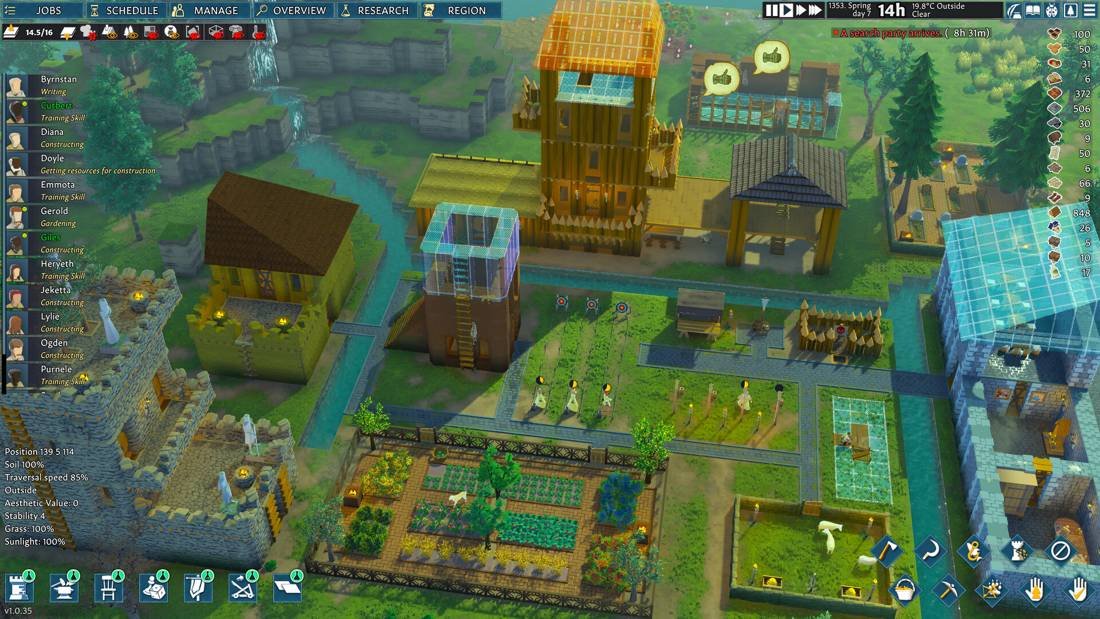
Screenshots and artwork are promotional images from the Going Medieval Steam store page and belong to Foxy Voxel and Mythwright.
Other guides from this collection.
These guides sit closest to Going Medieval in our data, either because they share genres or because they are about as hard to run. The demand scores use one common scale.
At the time we checked (2026-11-02) Steam showed 8,730 reviews with a Very Positive rating and 88% positive. That is a useful signal for how widely played Going Medieval is.
Going Medieval has been out for roughly 8 months, which means drivers and patches are likely still changing its performance. Re-check settings after major updates.
Details here come from Steam's public store listing. Frame rates here are modelled, since we have not tested the game on every card.
A short, honest note on how the numbers are produced.
Here is what feeds the estimates: demand 23 from the recommended card, CPU score 34 (from the listed processor line), and a 1080p High VRAM figure of 4 GB (estimated from the demand score).
In short: card performance divided by game demand, adjusted for resolution, preset and DLSS, FSR or XeSS-style upscaling, reduced when VRAM is short and capped by processor speed.
All FPS, VRAM and CPU figures are modelled. They are meant for comparing hardware and settings, and your own testing should have the last word.
Short answers to the most common questions about running Going Medieval on PC.
Expect to need at least NVIDIA GeForce GTX 1050 Ti (4 GB) or AMD Radeon RX 580 (4 GB), ideally NVIDIA GeForce GTX 1660 Super / RTX 2060 or AMD Radeon RX 6600 XT. Steam pairs that with Intel Core i5-10600K / i7-10700 or AMD Ryzen 5 3600 XT, and memory of 8 GB RAM (minimum) or 16 GB RAM (recommended). Storage needed is 2 GB available space.
Check the table of verdicts and use the checker for your exact CPU, GPU and RAM. In the model, 60 FPS at 1080p on High begins at the GTX 1660 Super.
For 60 FPS at 1080p on High you want at least the GTX 1660 Super. Among RTX 50 cards the RTX 5050 is the first to clear it.
For a smooth 1440p you want the RTX 2060 at minimum, and among RTX 50 cards the RTX 5050 is the first that gets there.
At High settings it should manage roughly 141 FPS (1080p) and 91 FPS (1440p). 8 GB of VRAM is comfortable for 1440p, so you can usually raise the settings.
In our estimates it manages close to 212 FPS at 1440p on High, and about 238 FPS with Quality upscaling. Real results vary with drivers, the scene and your processor.
For 4K you want a high-end card with DLSS, FSR or XeSS-style upscaling. In our estimates the RTX 5050 is the first desktop RTX 50 card to achieve 60 FPS at 4K on High with Quality upscaling.
On High settings the model wants roughly 4 GB at 1080p, 5.2 GB at 1440p and 7.2 GB at 4K. An 8GB card is therefore fine at 1080p and fine at 1440p.
Our estimate is 4 GB at 1080p, 5.2 GB at 1440p and 7.2 GB at 4K on High settings. That is derived from the publisher recommended specs, so it is a guide rather than a measurement.
For the processor, Steam suggests Intel Core i5-10600K / i7-10700 or AMD Ryzen 5 3600 XT and lists Intel Core i5-9400F or AMD Ryzen 5 2600 as the minimum, and Core i3-12100F, Ryzen 5 3600, Core i5-12400F, Ryzen 5 5600 and faster should stay above 60 FPS on our figures.
RAM is 8 GB RAM at minimum and 16 GB RAM recommended. Once the operating system and background apps are counted, 16 GB is a sensible target.
Plan for 2 GB available space of free space. Steam does not state an SSD requirement, but an SSD is recommended for loading times.
The laptop GPUs that hold 60 FPS at 1080p on High at typical power are RTX 5050 Laptop, RTX 5060 Laptop, RTX 5070 Laptop, RTX 5070 Ti Laptop, RTX 5080 Laptop, RTX 5090 Laptop. Wattage and cooling will change that.
Try High with the best upscaler in the menu, then reduce shadows and volumetrics if you need more frames. Use the settings table as a first guess for your card.
It lands on 23 in our graphics demand scale (ahead of 68% of 937 games), a moderately demanding result. The CPU score of 34 beats 83% of the set.
Check the upgrade section: it shows what each step up gains at 1440p in this game, which is the best way to weigh cost against benefit.
Get a verdict for your hardware for this game
Work out settings for the FPS you want
See the memory it needs on your card
Line up all the DLSS, FSR or XeSS-style upscaling and frame generation options
Compare up to three graphics cards
See whether your CPU or GPU is the limit
Independent site. Not affiliated with or endorsed by Foxy Voxel, Mythwright, Valve, NVIDIA, AMD or Intel. Game names, images and trademarks belong to their owners. Frame rates, VRAM and CPU figures are modelled figures, not benchmarks.