
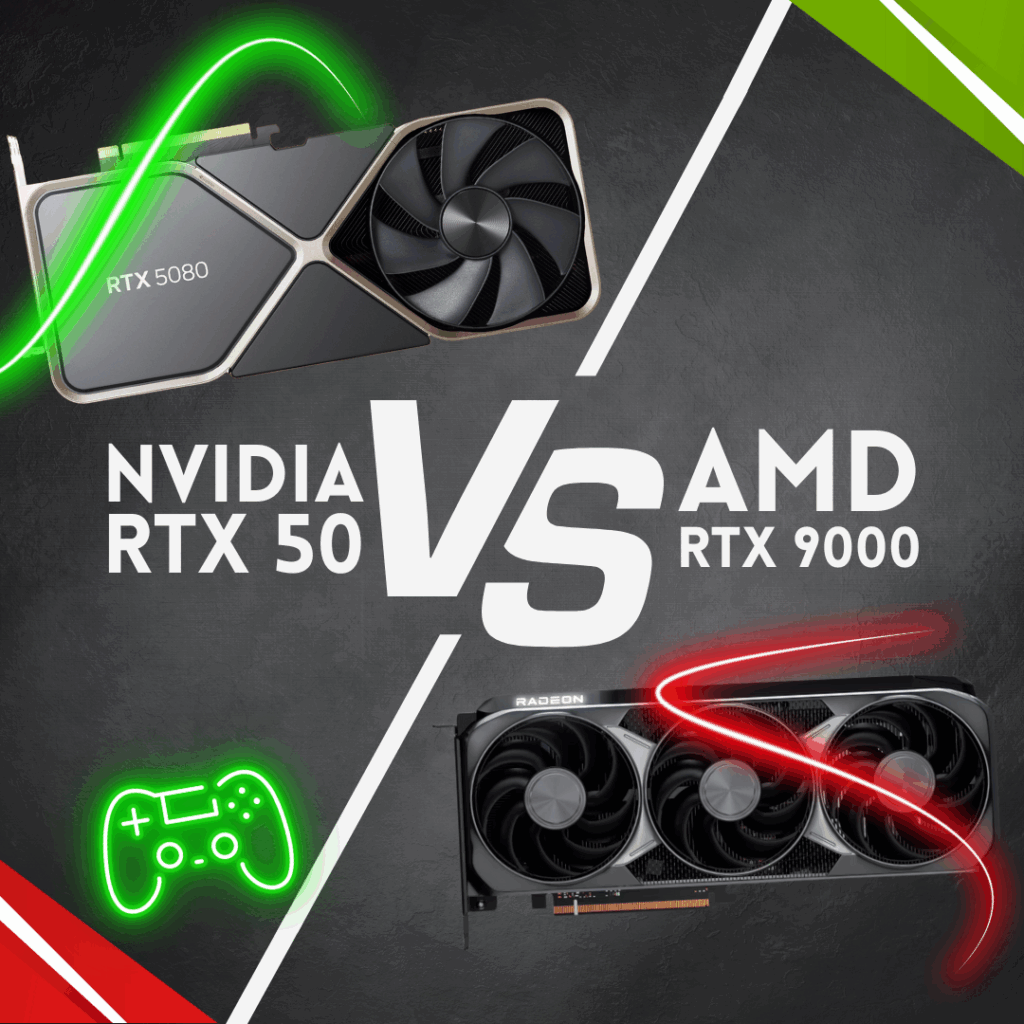
2025 marks a defining moment in the GPU wars. NVIDIA’s RTX 50 Series (“Blackwell”) and AMD’s Radeon RX 9000 Series (RDNA 4) are not just incremental upgrades—they represent two different philosophies for how gamers experience next-gen performance, especially across ray tracing, AI-assisted rendering, and power efficiency.
For UK gamers, this rivalry means one thing: more choice at every tier from enthusiast 4K builds powered by the RTX 5090 to value-driven 1440p rigs built around the RX 9070 XT. But understanding what each card brings to your gaming setup is key before you spend your hard-earned pounds.
Core Architectural Difference
- NVIDIA RTX 50 Series (Blackwell Architecture):
- Built for AI-accelerated rendering, DLSS 4, and Ray Reconstruction, pushing frame rates and fidelity to cinematic levels.
- Introduces GDDR7 memory for higher bandwidth, and refined tensor cores optimized for AI workloads, including next-gen game upscaling and simulation physics.
- Focuses on premium experience and visual accuracy, often consuming more power but delivering top-end results.
- AMD RX 9000 Series (RDNA 4 Architecture):
- Centres on efficiency, rasterisation power, and value per frame—making it strong for non-RT workloads.
- Uses GDDR6 memory but pairs it with improved Infinity Cache and stronger ray-accelerators to narrow the RT gap.
- Offers FSR 4 and HYPR-RX 2, AMD’s latest performance suite combining upscaling, latency reduction, and frame generation.
The Battle of Features
| Feature | RTX 50 Series | RX 9000 Series |
|---|---|---|
| Upscaling | DLSS 4 + Multi-Frame Generation | FSR 4 + HYPR-RX 2 |
| AI Cores | Dedicated Tensor Cores | Software-level compute acceleration |
| Ray Tracing | Industry-leading (Path Tracing ready) | Much improved, but still slightly behind |
| Memory | GDDR7 (faster) | GDDR6 (efficient) |
| Power Draw | Higher (850–1300 W system) | Lower (700–1000 W system) |
| Ideal Use | 4K/8K, RT, creators, AI-heavy titles | 1440p/4K, esports, value builds |
What This Means for Gamers in the UK
NVIDIA dominates the absolute-performance category—if you’re chasing maxed-out fidelity with path tracing in games like F1 25, Cyberpunk 2077, or DOOM: The Dark Ages, the RTX 50 Series is unmatched.
However, AMD’s RX 9000 cards deliver impressive efficiency and performance-per-pound, making them excellent for gamers who want smooth 1440p or 4K gameplay without spending over £1,000 on a GPU.
ro Tip: UK electricity costs are higher than many regions—AMD’s lower-draw cards can save you money in the long run, while NVIDIA’s AI-boosted cards deliver unmatched longevity for next-gen titles.
Real-World Performance & Benchmarks — RTX 50 vs RX 9000 in UK-Relevant Games
When it comes to real gaming performance, the NVIDIA RTX 50 Series and AMD RX 9000 Series show clear strengths depending on how you play — and what you play. Let’s break down what recent UK and EU benchmark data reveal, using major 2025 releases such as F1 25, DOOM: The Dark Ages, Starfield, and Cyberpunk 2077 2.1.
1. 4K & Ray-Traced Titles (Cinematic / AAA)
If you game at 4K with ultra settings + ray tracing, NVIDIA’s RTX 5090 / 5080 take the performance crown.
- In F1 25, RTX 5090 with DLSS 4 + Ray Reconstruction delivers ~160–200 FPS @ 4K Ultra, while RX 9070 XT averages around 120–130 FPS using FSR 4 Quality.
- In Cyberpunk 2077 2.1 (Path Tracing), DLSS 4 boosts the RTX 5080 to playable 90 FPS @ 4K, compared to ~60 FPS on the RX 9000’s best cards.
Summary: RTX 50 Series = best raw fidelity, cleaner ray tracing, more stable frame pacing. RX 9000 = strong but slightly less refined in extreme RT workloads.
2. 1440p & Competitive Gaming (High-Refresh / Esports)
At 1440p or 1080p, the gap narrows considerably. In titles like Apex Legends, Valorant, and Call of Duty 2025:
- RTX 5070 Ti (£699 UK RRP) and RX 9060 XT (£599 UK RRP) often deliver 250–400 FPS, depending on the title.
- In Overwatch 2, both cards hit near CPU-limit territory (~400 FPS+). AMD cards show better power efficiency, while NVIDIA maintains slightly lower latency with Reflex + DLSS Frame Gen.
Summary: At mainstream resolutions, RX 9000 provides fantastic value; RTX 50 offers smoother latency and more future-proof AI options.
3. Content Creation & AI Workloads
For streamers, editors, and creators, RTX 50 GPUs lead due to:
- Dedicated Tensor Cores for AI workloads (video upscaling, frame generation, Blender, Stable Diffusion).
- Broader NVIDIA Studio driver ecosystem.
RX 9000 cards still perform very well in raw raster / compute tasks but lack dedicated AI acceleration.
UK Insight: If you’re a creator using DaVinci Resolve Studio or Adobe Premiere Pro, RTX 50 will render and export projects faster.
4. Efficiency & Power Draw (UK Electricity Context)
With UK power prices averaging £0.29 per kWh, efficiency matters.
- RTX 5090 systems under load draw ~850 W.
- RX 9070 XT builds average ~650 W under similar load.
Over a gaming year (3 hrs/day average), that’s ~£45–£60 difference in electricity cost — small, but worth noting for budget-conscious gamers.
Verdict: RTX 50 consumes more power but gives maximum headroom. RX 9000 offers better £/FPS and lower long-term cost.
In short:
- For pure performance + future-proof visuals → NVIDIA RTX 50 Series.
- For balanced performance + value + efficiency → AMD RX 9000 Series.
Feature Ecosystem & Software Advantages — DLSS 4 vs FSR 4, Reflex vs HYPR-RX 2
When comparing the RTX 50-Series and RX 9000-Series, the biggest differences aren’t just in hardware power — they’re in the software ecosystem.
Both NVIDIA and AMD have built powerful feature stacks designed to maximise frame rates, improve visual fidelity, and reduce latency.
Here’s how the key technologies differ, especially in 2025’s biggest games such as F1 25, Dune: Awakening, Starfield, and Cyberpunk 2077 2.1.
DLSS 4 — NVIDIA’s AI Advantage
DLSS 4 (Deep Learning Super Sampling) is the fourth-generation upscaling and frame generation suite, built into the RTX 50 Series’ Blackwell architecture.
It includes three major technologies:
- Super Resolution – AI-powered upscaling that reconstructs detail from a lower internal render resolution.
- Frame Generation 2.0 / Multi-Frame Generation – inserts AI-generated frames between real ones for smoother gameplay.
- Ray Reconstruction – replaces traditional denoising to deliver sharper, more accurate ray-traced lighting and reflections.
In F1 25 and DOOM: The Dark Ages, DLSS 4 provides a 4× to 8× performance boost in heavy ray-traced scenes, with cleaner motion and fewer ghosting artefacts.
UK Insight: DLSS 4 is already supported in nearly every major AAA PC release shipping in 2025 — meaning UK players buying an RTX 5080 or 5090 are investing in a maturing, wide-supported tech ecosystem.
FSR 4 / HYPR-RX 2 — AMD’s Open-Source Counterpart
AMD’s latest suite, FSR 4 (FidelityFX Super Resolution 4), builds on the FSR 3 base and adds improved temporal stability.
Combined with HYPR-RX 2, AMD now bundles:
- FSR 4 Super Resolution + Frame Generation (works on Radeon and even NVIDIA/Intel GPUs)
- Anti-Lag + 2 for latency reduction
- Radeon Boost for dynamic resolution scaling
While FSR 4 shows strong results in Starfield and Avowed, visual sharpness still trails DLSS 4 slightly — especially in motion or complex lighting.
However, it’s open-source and GPU-agnostic, a major plus for cross-brand builders.
UK Angle: For gamers on a tighter budget, AMD’s open technology makes it easier to get great performance without paying for premium RTX hardware.
Reflex vs Anti-Lag + 2 — Latency Wars
- NVIDIA Reflex integrates at driver level and in-game APIs, cutting system latency dramatically (by up to 50% in esports titles like Valorant and CS 2).
- AMD Anti-Lag + 2 offers similar benefits but sometimes requires more per-game tweaking and isn’t yet as widely adopted.
Competitive UK players who value consistent frame pacing and latency — particularly those with 240–360 Hz monitors — will notice smoother responsiveness on Reflex-enabled RTX builds.
Software & Driver Ecosystem
| Feature | NVIDIA RTX 50 Series | AMD RX 9000 Series |
|---|---|---|
| Upscaling Tech | DLSS 4 (Super Res + MFG + Ray Reconstruction) | FSR 4 + HYPR-RX 2 |
| Latency Control | NVIDIA Reflex | Anti-Lag + 2 |
| Creator Tools | NVIDIA Studio Drivers, Broadcast AI Suite | Radeon Pro Software for Creators |
| Ray Tracing | Path Tracing + Ray Reconstruction (very advanced) | Improved RT Cores, less efficient at 4K |
| Ecosystem Maturity | Very mature, wide game adoption | Improving rapidly, but fewer FSR 4-native titles |
Verdict — Which Ecosystem Wins?
- DLSS 4 / RTX 50 Series = Best image quality, most refined frame generation, stronger latency control, ideal for future-proof gaming and creative workloads.
- FSR 4 / RX 9000 Series = Excellent open-source performance uplift, broader compatibility, better value for money, especially below 4K or in hybrid rendering titles.
Price, Availability & Value for UK Buyers
When deciding between the NVIDIA RTX 50-Series and AMD RX 9000-Series, UK gamers face a familiar balancing act — raw power and prestige versus price-to-performance and practicality. Hardware capabilities matter, but so does what you actually pay at checkout and what your system costs to run long-term on UK electricity prices.
RTX 50-Series — Premium Performance at a Premium Price
NVIDIA’s RTX 5090, 5080, 5070 and related models sit firmly in the high-end category. Early UK listings from retailers like Overclockers UK and Scan show:
- RTX 5090: around £1,849–£1,999 depending on brand and cooler design
- RTX 5080: roughly £1,099–£1,249
- RTX 5070 Ti / 5070: expected £749–£899 range
These prices reflect not just performance, but access to NVIDIA’s advanced software ecosystem — DLSS 4, Ray Reconstruction, Reflex, Broadcast AI, and Studio Drivers.
However, they also bring higher system costs: you’ll likely need a high-wattage PSU (850 W+), larger case airflow, and perhaps upgraded cooling.
UK Tip: If you’re eyeing a 4K or ultra-wide 144 Hz monitor, the RTX 5080 and 5090 justify the spend — but check PSU and case compatibility first.
RX 9000-Series — Strong Value and Broader Reach
AMD’s RX 9070 XT, 9070, 9060 XT and lower-tier cards target gamers who want big gains without breaking £1,000.
UK pricing currently hovers around:
- RX 9070 XT: ~£899–£999
- RX 9070: ~£699–£799
- RX 9060 XT: ~£499–£599
Performance sits slightly below NVIDIA’s flagship cards in full ray-traced scenarios, but price-per-frame is often better — especially in rasterised or hybrid rendering games (like F1 25, Starfield, Baldur’s Gate 3).
Power efficiency is higher, meaning lower electricity use — a subtle but real saving in UK households.
UK Tip: If you play mostly at 1440p or “4K High” without chasing every visual toggle, the RX 9000-Series delivers 90–95 % of top-tier performance for much less money.
Cost-of-Ownership Snapshot (Estimated UK Mid-2025)
| Factor | RTX 50 Series | RX 9000 Series |
|---|---|---|
| GPU Cost | £749 – £1,999 | £499 – £999 |
| PSU Requirement | 850–1000 W recommended | 700–850 W typical |
| Avg Gaming Power Draw | 400–600 W | 300–450 W |
| Annual Electricity Cost (heavy gamer)* | £180 – £260 | £130 – £190 |
| Ecosystem Software | DLSS 4 / Reflex / Ray Reconstruction | FSR 4 / HYPR-RX 2 / Anti-Lag + 2 |
| Price-Per-Performance (avg £ per fps) | Slightly higher | Better in mid-range |
*Based on ~4 hours daily gaming, £0.30 per kWh UK average.
UK Availability & Stock Notes
- NVIDIA cards tend to sell out quickly on launch, then stabilise after 2–3 months; Founders Edition models often limited to the NVIDIA Store or Scan UK.
- AMD cards are usually easier to find across multiple retailers (including Box.co.uk and Ebuyer).
- Both brands have seen small price drops since July 2025, but exchange rates and import duty keep them higher than US MSRP.
Verdict — Value in the UK Market
- If your budget is over £1,500, you’re chasing the best visuals, or you stream/create content → the RTX 50-Series earns its premium.
- If you want excellent 1440p–4K gaming with fewer system demands and better efficiency → the RX 9000-Series offers smarter value.
In short:
👉 NVIDIA gives you bragging-rights and bleeding-edge visuals.
👉 AMD gives you almost-as-good performance for hundreds less — and smaller energy bills.
Final Verdict & Buying Recommendations for UK Gamers
Now that we’ve compared specs, power, pricing, and real-world UK factors, it’s time to answer the question every gamer’s asking — which GPU family should you actually buy in 2025: NVIDIA RTX 50-Series or AMD RX 9000-Series?
TL;DR Summary
| Category | Winner | Why It Wins |
|---|---|---|
| 🔋 Power Efficiency | AMD RX 9000-Series | Lower TDP, cheaper PSUs, cooler systems — ideal for UK homes with high energy costs. |
| 🧠 AI Features & Ray Tracing | NVIDIA RTX 50-Series | DLSS 4, Ray Reconstruction, superior RT cores and path tracing capabilities. |
| 💸 Value & Price-per-FPS | AMD RX 9000-Series | Delivers 85–95 % of NVIDIA’s performance for up to 40 % less cost. |
| 🧊 Thermals & Cooling | AMD RX 9000-Series | Generally cooler-running cards; less demand on case airflow and AIOs. |
| 🧰 Software Ecosystem | NVIDIA RTX 50-Series | DLSS 4, Reflex, Broadcast, Studio Drivers — better for streamers, creators, and enthusiasts. |
| 🏁 Overall Gaming Experience | Depends on Budget & Resolution | NVIDIA dominates in 4K Ultra and ray-traced workloads; AMD shines in 1440p High builds and better value. |
Buying Guidance for UK Gamers
Choose the RTX 50-Series if you:
- Play at 4K Ultra or 8K, or use VRR high-refresh monitors (165 Hz+).
- Want the absolute best graphics and smoothest ray-tracing experience.
- Plan to use NVIDIA’s AI tools (DLSS 4, Reflex, Broadcast) for streaming or content creation.
- Have a budget above £1,500 for your GPU and matching high-end PSU + cooling setup.
- Want long-term future-proofing for next-gen AAA titles like Cyberpunk 2077 2 or Starfield Next.
Example RTX 50 Builds:
- RTX 5080 + Ryzen 7 7800X3D + Corsair RM1000e PSU — balanced 4K setup.
- RTX 5090 + Intel i9-14900KS + Seasonic Prime TX-1300 PSU — no-compromise 4K/8K beast.
Choose the RX 9000-Series if you:
- Game mainly at 1440p Ultra or 4K High settings.
- Prefer better value (£/fps) and lower system power draw.
- Want strong raster performance and good (if slightly lower) ray tracing.
- Care about lower total build cost (PSU, case, cooling).
- Use a FreeSync monitor or already in the AMD ecosystem (Smart Access Memory, HYPR-RX 2).
Example RX 9000 Builds:
- RX 9070 XT + Ryzen 7 7800X3D + Corsair RM850e PSU — efficient and powerful 1440p rig.
- RX 9060 XT + Intel i5-14600K + Seasonic Focus GX-750 PSU — excellent value mid-range UK gaming PC.
Verdict — What to Buy in 2025
For most UK gamers, the AMD RX 9000-Series offers smarter value and lower total cost while delivering nearly top-tier performance.
But if you want maximum performance, top-end ray tracing, or AI features, and can afford the PSU and cooling demands, the NVIDIA RTX 50-Series remains the flagship choice. Simple rule:
- Performance first? Go RTX 50-Series.
- Value & efficiency first? Go RX 9000-Series.

Valuable information. Lucky me I found your site by accident, and I am shocked why this accident did not happened earlier! I bookmarked it.