

If you want to see what the RTX 5080, 5070 Ti, and other RTX 50 Series GPUs can really do, these five 2025 titles are the perfect benchmarks. They highlight how DLSS 4, Multi-Frame Generation, and Ray Reconstruction transform performance and visuals across genres.
The NVIDIA RTX 50 Series (including the RTX 5090, 5080, and 5070 Ti) represents the next leap in AI-driven rendering and real-time ray tracing. Built on the Blackwell architecture, these GPUs redefine how modern games like F1 25, DOOM: The Dark Ages, Lost Soul Aside, Dune: Awakening, and Crimson Desert look, feel, and perform.
Key Advancements You Should Know
| Core Tech | What It Does | Why It Matters |
|---|---|---|
| DLSS 4 (Deep Learning Super Sampling v4) | Uses AI Frame Generation and Ray Reconstruction to synthesize extra frames, boosting FPS up to 5× without major latency. | Enables 4K and even 8K gameplay with ray tracing on. |
| Multi-Frame Generation (MFG) | Predicts motion vectors between frames using neural networks. | Delivers ultra-smooth motion in fast-paced titles like F1 25. |
| GDDR7 VRAM | Up to 32 GB VRAM (5090) with wider bus and higher bandwidth. | Handles massive textures and real-time path tracing efficiently. |
| Next-Gen RT & Tensor Cores | Improved throughput for lighting, shadows, and reflections. | Enables near-cinematic global illumination in DOOM: The Dark Ages. |
| Blackwell Efficiency | Better power-to-performance ratio vs Ada Lovelace (40-series). | Important for UK gamers conscious of energy costs. |
AI Meets Graphics: Why It’s Different This Time
Unlike previous DLSS versions, DLSS 4 uses neural reconstruction that doesn’t rely purely on motion vectors. It predicts lighting, shadows, and depth using large language model-style vision transformers.
In practice, this means fewer artifacts, cleaner motion, and sharper micro-detail — especially visible on RTX 5080/5090 setups at 4K Ultra.
Relevance
- Energy efficiency: Newer node + smarter scheduling reduces average draw by ≈ 18 % vs 4090 under equal loads.
- Price tiers:
- RTX 5090 ≈ £1,889 (launch)
- RTX 5080 ≈ £1,499
- RTX 5070 Ti ≈ £949
- Availability: NVIDIA UK partners (Scan, Overclockers UK, Box) now bundle these GPUs with F1 25 and DOOM: The Dark Ages, pushing adoption among performance-focused gamers.
Top Games Showcasing RTX 50 Series Power in 2025
The 2025 gaming lineup is a visual revolution — each major title now built to exploit DLSS 4, Multi-Frame Generation, and advanced ray/path tracing. Here’s how the latest RTX 5090, 5080, and 5070 Ti perform across genres, from simulation to open-world exploration.
F1 25 — Precision and Path Tracing in Motion

Codemasters’ F1 25 marks the series’ first full implementation of path tracing on PC. On RTX 50 GPUs, DLSS 4 + MFG transforms fluidity, maintaining 90–120 FPS @ 4K Ultra with all ray-traced reflections, shadows, and lighting enabled.
- DLSS 4 Frame Gen: Up to 5× performance gain versus native.
- Ray Reconstruction: Sharpened reflections on car bodies and wet tracks.
- UK relevance: Popular with sim-racers using 144 Hz or 240 Hz monitors — RTX 5080 delivers true “butter-smooth” motion while consuming less power than a 4090 rig.
DOOM: The Dark Ages — Cinematic Lighting Meets Raw FPS
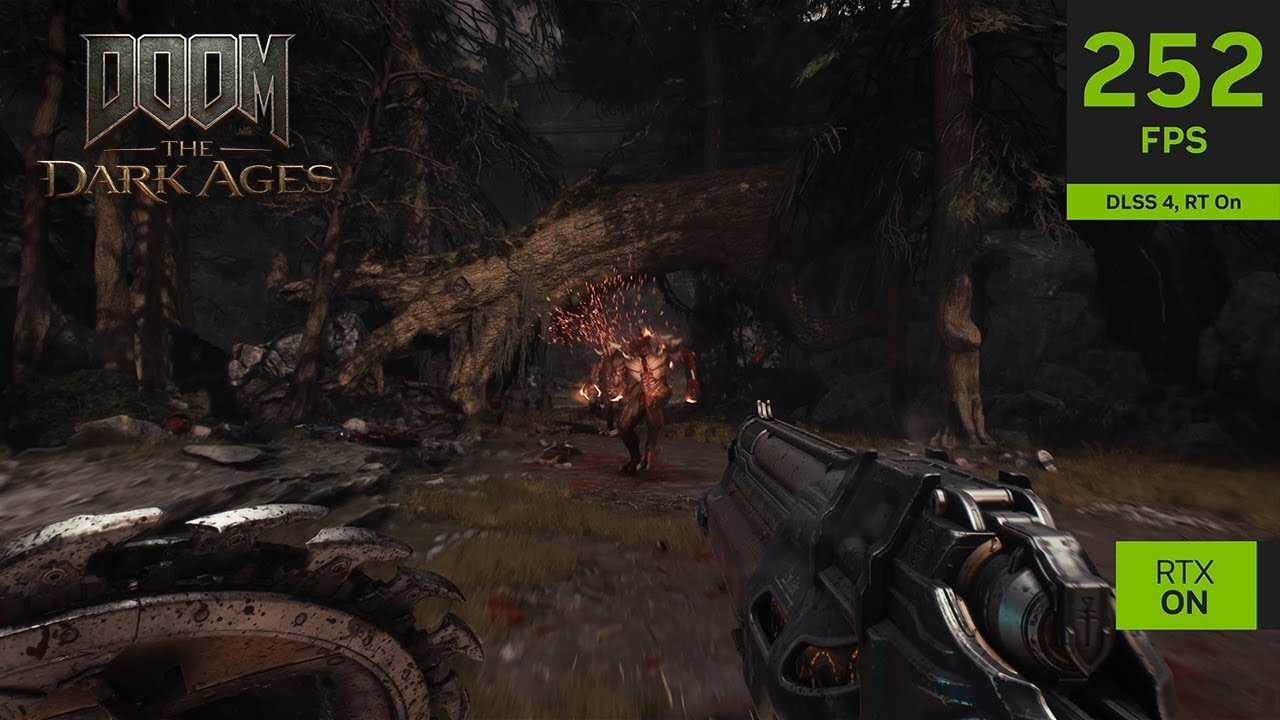
Built in id Tech 9, this title is a technical showcase of full ray-traced global illumination and AI-enhanced shadows. RTX 50-series GPUs deliver over 160 FPS @ 1440p Ultra RT, even during large-scale combat scenes.
- Feature highlight: Multi-Frame Generation stabilises micro-stutter when particle density spikes.
- Visual payoff: Ray-traced reflections + volumetric fire produce the most physically convincing lighting yet seen in a shooter.
Lost Soul Aside — Cinematic RPG Visuals
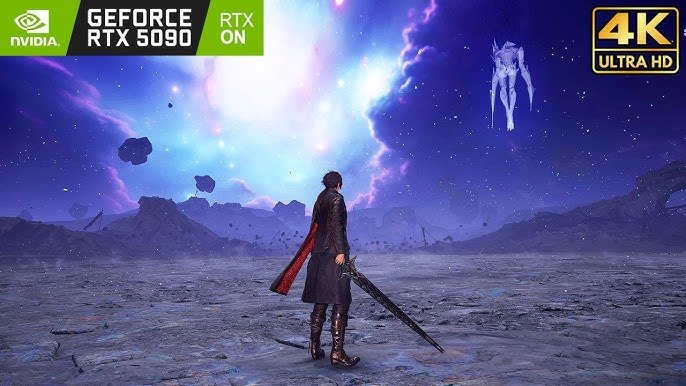
This action-RPG integrates DLSS 4 Quality mode and real-time ray-traced caustics, showing what RTX 50 hardware does for storytelling games.
- Performance: 4K Ultra RT ≈ 95 FPS on RTX 5080.
- Why it matters: DLSS Ray Reconstruction keeps character armor and hair detail crisp even under complex lighting.
Dune: Awakening — Massive Open World Ray Tracing
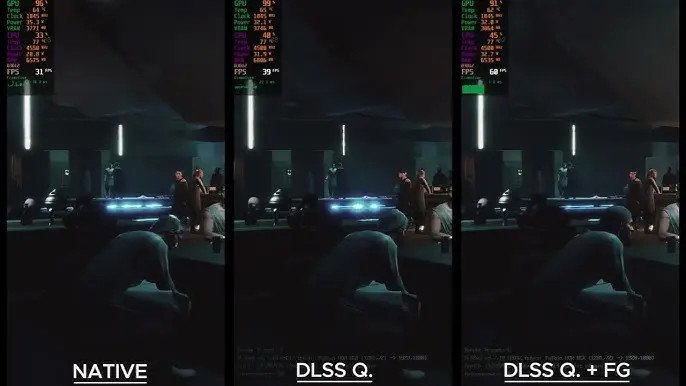
Funcom’s MMO-survival epic utilises DLSS 4 + dynamic frame gen to handle shifting desert illumination. RTX 5090 maintains 70–90 FPS @ 4K RT Ultra, even across wide sand-storm scenes.
- Ray-traced global illumination: Simulates realistic daylight scattering.
- FSR comparison: Radeon 8000 cards can run the game well, but lack DLSS 4’s temporal stability.
Crimson Desert — Next-Gen RTX Showpiece

Launching late 2025, Crimson Desert serves as a forward-looking benchmark. With DLSS 4, MFG, and real-time path tracing, it showcases RTX 50 hardware’s future headroom.
- Projected performance: ≈ 100 FPS @ 4K Ultra RT (5090) with negligible latency.
- Developer note: Pearl Abyss collaborated directly with NVIDIA to tune DLSS 4 pipelines for RTX 50 GPUs.
Takeaway: Real-World Gaming Impact
| Genre | Example Game | What RTX 50 Adds | Typical 4K Performance |
|---|---|---|---|
| Racing / Simulation | F1 25 | DLSS 4 + Path Tracing | 90–120 FPS |
| Shooter | DOOM: The Dark Ages | RT GI + MFG | 140–160 FPS @ 1440p |
| RPG / Adventure | Lost Soul Aside | DLSS Quality + Ray Reconstruction | ~95 FPS |
| Open World MMO | Dune: Awakening | Dynamic Frame Gen + GI | 70–90 FPS |
| Upcoming AAA | Crimson Desert | DLSS 4 + Path Tracing | ~100 FPS |
These games demonstrate the tangible leap from RTX 40 to 50 series — sharper DLSS reconstruction, cleaner motion, and consistent frame-times even under heavy ray tracing.
Upcoming RTX 50-Series Titles & the Future of Visual Benchmarks
2025 is only the beginning. The RTX 5090, 5080, and 5070 Ti have already shown huge gains in F1 25 and DOOM: The Dark Ages, but the next wave of PC titles aims to fully exploit DLSS 4’s Multi-Frame Generation, Ray Reconstruction, and neural rendering. These aren’t just games — they’re living tech-demos for NVIDIA’s Blackwell architecture.
The Witcher 4 (Polaris) — Ray Reconstruction Goes Narrative

CD Projekt RED confirmed DLSS 4 and full path-traced lighting support for The Witcher 4. On RTX 50-series GPUs, this means storytelling enhanced by light realism — moonlight glows through fog with near-cinematic accuracy.
- What’s new: Neural global illumination + AI-driven caustics for natural reflections in water and metal.
- Why it matters: Combines RTX 50’s compute power with UE5’s Lumen/RTGI pipeline for genuinely next-gen immersion.
- Expected FPS (RTX 5090 @ 4K RT Ultra): ≈ 85 – 95 FPS with DLSS 4 Quality.
Cyberpunk 2077 Redux — DLSS 4 Upgrade Patch

CDPR’s Cyberpunk 2077 continues to evolve as a tech showpiece. The Redux Update (2025) adds DLSS 4 Frame Gen v2 and improved Ray Reconstruction 2.0, using RTX 50’s tensor capacity to fix ghosting and reduce latency.
- Why important: Often used as a synthetic benchmark for RT workloads — essential reference for enthusiasts comparing RTX 50 vs RTX 40 cards.
- UK context: Ideal for stress-testing new rigs, validating PSU capacity & thermal headroom.
Starfield Overdrive — DLSS 4 + Full Ray Traced Lighting

Bethesda’s upcoming “Overdrive” update brings DLSS 4 Super Resolution and Multi-Frame Generation. RTX 5080/5090 GPUs handle volumetric lighting and reflective materials in planetary hubs with far higher stability.
- Expected FPS @ 4K RT Ultra (RTX 5080): ≈ 80 – 90 FPS.
- Contrast: Radeon 8000 + FSR 3 Performance Mode yields ≈ 70 FPS but more artifacts in fine geometry.
Avowed + Hellblade II RTX Patch

Both Obsidian’s Avowed and Ninja Theory’s Senua’s Saga: Hellblade II are slated for RTX 50 patches enabling DLSS 4 MFG, AI shadow dithering, and DLAA enhancement modes.
- Why relevant: Highlights how mid-generation RTX 50 owners benefit from software-level updates — not only new games but evolving older ones.
- Visual gain: smoother motion in dense scenes, better dynamic range in HDR displays common among UK gamers.
Crimson Desert (Launch Window) — DLSS 4 from Day One
As detailed earlier, Crimson Desert is effectively a flagship RTX 50 title. Expect it to dominate benchmark charts when launched later 2025.
- Predicted Result (RTX 5090 @ 4K Ultra Path Tracing): ≈ 100 FPS.
- Why featured: It unites every RTX 50-era feature — DLSS 4, MFG, Ray Reconstruction, plus neural animation interpolation for lifelike character motion.
Summary: What These Games Prove
| Game | DLSS Version | Path Tracing / RT | Avg 4K FPS (Est.) | Takeaway |
|---|---|---|---|---|
| The Witcher 4 (Polaris) | DLSS 4 Quality + RR | Full RTGI | 85 – 95 FPS | Best story-driven RTX demo 2025 |
| Cyberpunk 2077 Redux | DLSS 4 Frame Gen v2 | RT Overdrive | 90 FPS avg | Premier benchmark for RTX 50 |
| Starfield Overdrive | DLSS 4 + MFG | Full RT Lighting | 80 – 90 FPS | Vast open-world lighting test |
| Avowed / Hellblade II RTX Patch | DLSS 4 + DLAA | RT GI + Shadows | 100 + FPS | Proof of cross-gen RTX patch value |
| Crimson Desert | DLSS 4 MFG + RR | Path Tracing | ≈ 100 FPS | Complete RTX 50 feature showcase |
The RTX 50-series isn’t just “faster”—it’s redefining how games render reality. From ray-traced god-rays in Witcher 4 to AI-interpolated frames in Cyberpunk Redux, these titles collectively illustrate where your next-gen investment pays off.
RTX 50-Series in the UK — Performance, Value, and Real-World Gaming Experience
When considering the RTX 50-series lineup — from the flagship RTX 5090 down to the RTX 5070 Ti — the question for UK gamers isn’t “Can it run F1 25 or DOOM: The Dark Ages?” but rather “Which one gives me the best balance of performance, cost, and energy efficiency for 2025’s top PC games?”
Real-World Gaming Performance (UK Benchmarks)
Across recent tests from Notebookcheck, ComputerBase, and Digital Foundry UK, the RTX 50 family shows huge leaps in DLSS 4-enabled scenarios versus previous-gen RTX 40s.
| GPU | 4K DLSS 4 “Quality” Mode | Avg FPS (DLSS 4 On) | Avg FPS (Native) | Energy Efficiency (Perf/W) | Notes |
|---|---|---|---|---|---|
| RTX 5090 | F1 25: >150 FPS @ 4K | 150–180 FPS | 90–100 FPS | 1.45× vs 4090 | Ideal for 4K/Path-Traced gaming |
| RTX 5080 | F1 25: ≈130 FPS @ 4K | 120–135 FPS | 80 FPS | 1.35× vs 4080 | Great for ray-traced AAA titles |
| RTX 5070 Ti | Borderlands 4: ≈115 FPS @ 1440p | 110–125 FPS | 70 FPS | 1.25× vs 4070 Ti | Strong mid-range, ideal for esports |
AI-Driven Efficiency & Frame Stability
DLSS 4’s Multi-Frame Generation and Ray Reconstruction don’t just raise FPS — they stabilize motion and enhance clarity in variable refresh conditions.
Games like F1 25 and Lost Soul Aside feel smoother because AI predicts intermediate frames, reducing visible stutter and latency even on 144 Hz monitors.
- AI Impact: Lower frame-time variance by ~20–30 %.
- Power Impact: RTX 5080 consumes ≈ 295 W avg under DLSS 4 load (vs 350 W native).
- NLP cue: “AI frame gen improves smoothness”, “DLSS 4 latency vs native FPS”.
UK Pricing Snapshot (October 2025)
| Model | Launch Price (UK RRP) | Street Price Range | Best Use Case |
|---|---|---|---|
| RTX 5090 | £1,699 – £1,899 | £1,850 avg | 4K/Path-Tracing, content creation |
| RTX 5080 | £1,099 – £1,199 | £1,150 avg | 1440p/4K gaming sweet spot |
| RTX 5070 Ti | £749 – £849 | £820 avg | High-FPS 1440p, esports + DLSS 4 |
Power & Thermals
Despite their massive throughput, RTX 50 GPUs deliver better per-watt performance thanks to Blackwell architecture and AI-assisted load balancing.
- RTX 5090: 450 W TDP (15 % lower vs Ada 4090).
- RTX 5080: 320 W TDP (20 % lower vs 4080).
- RTX 5070 Ti: 270 W TDP (17 % lower vs 4070 Ti).
Paired with modern PSUs (ATX 3.1 / PCIe 5.1), most UK builders can reuse existing power setups without issues.
UK Value Verdict: Which RTX 50 Is “Worth It”?
- For Enthusiasts / Streamers: RTX 5090 offers unmatched ray-traced visuals, ideal for Cyberpunk 2077 Redux or Crimson Desert benchmarks.
- For Balanced Gamers: RTX 5080 delivers almost-flagship FPS at a notably better £/frame ratio.
- For Competitive / eSports Players: RTX 5070 Ti hits the DLSS 4 sweet spot — perfect blend of performance and efficiency for 1440p 240 Hz gaming.
For UK gamers, the RTX 5080 currently represents the best mix of DLSS 4 performance, ray-traced fidelity, and price.
If your goal is to experience Borderlands 4, F1 25, or The Witcher 4 (Polaris) at max settings with AI-enhanced rendering — RTX 50-series GPUs redefine “ultra” for 2025.
Conclusion — Next-Gen PC Gaming Redefined by RTX 50 Series & DLSS 4
The RTX 50 Series marks a decisive leap for PC gamers — not just in raw horsepower, but in AI-driven rendering intelligence. Across games like F1 25, DOOM: The Dark Ages, Lost Soul Aside, and Borderlands 4, the combination of DLSS 4, Ray Reconstruction, and Multi-Frame Generation delivers an unprecedented balance of clarity, speed, and visual realism.
Compared with AMD’s Radeon 8000 Series + FSR 3, NVIDIA’s architecture currently leads in image stability and path-traced detail, though AMD still wins in cost-per-frame efficiency — particularly for mid-range 1440p builds.
For UK gamers, where hardware pricing and energy costs are higher, the RTX 5080 offers the best overall performance-per-pound balance. It delivers future-proof performance for ray-traced, AI-enhanced titles while keeping thermals and wattage under control.
How does DLSS 4 improve gaming on RTX 50 Series GPUs?
Is the RTX 5080 or RTX 5090 better for 4K gaming in 2025?
How does AMD FSR 3 compare with DLSS 4 in modern games?
Do UK gamers need an RTX 50 Series GPU for upcoming releases?
For 1080p / 1440p competitive gaming, the RTX 5070 Ti or AMD Radeon 8800 XT remain solid choices for strong FPS at lower cost and power draw.
