Can my PC run it?
Test your own GPU, CPU and settings in this game
This is our PC performance guide for Waterpark Simulator, a Casual/Indie/Simulation game by CayPlay. It covers requirements, estimated FPS across 28 cards, memory needs, CPU and RAM advice, settings and what to expect on a gaming laptop.

Where this game sits among 937 modelled titles, and how that plays out for entry, mid-range and high-end cards.
On our demand scale Waterpark Simulator scores 23. That makes it harder to run than 68% of the 937 games in our data set, which we class as a mid-weight game for graphics hardware.
It comes from the recommended card on the Steam page (NVidia GeForce GTX 1070 or RX Vega 56 or equivalent), which we map onto a common performance scale and convert to 1080p High. Treat it as a relative guide.
On the CPU side, Waterpark Simulator scores 21, ahead of 21% of the 937 modelled games.
Official minimum and recommended specs for Waterpark Simulator, translated into frame rates.
These are the developer figures on Steam, and patches can change them.
The listed minimum is NVidia GeForce GTX 1050 or RX 570 or equivalent. Our model puts it near 43 FPS at 1080p on Low and 23 FPS on High, so treat it as an entry ticket rather than a target.
Step up to the recommended NVidia GeForce GTX 1070 or RX Vega 56 or equivalent and the model returns roughly 80 FPS at 1080p and 52 FPS at 1440p. That is above 60 FPS at 1080p, so the recommended spec reads as a comfortable 1080p target.
Steam asks for Intel Core i5-6400 at the recommended level. That class of processor tops out near 100 FPS in Waterpark Simulator in our model.
You will need 8 GB RAM of RAM at minimum or 8 GB RAM to match the recommended spec, plus 20 GB available space on your drive.
The lowest GPU we tested that hits each target in Waterpark Simulator, plus the first desktop RTX 50 card that does.
| Target | Lowest card tested | First RTX 50 card | Also reaches it |
|---|---|---|---|
| Playable, 30 FPS at 1080p Low | GTX 1060 6GB | RTX 5050 | GTX 1660 Super, RTX 2060, RX 6600 |
| 1080p 60 FPS, Medium | GTX 1060 6GB | RTX 5050 | GTX 1660 Super, RTX 2060, RX 6600 |
| 1080p 60 FPS, High | GTX 1660 Super | RTX 5050 | RTX 2060, RX 6600, RTX 3060 12GB |
| 1440p 60 FPS, High | RTX 2060 | RTX 5050 | RX 6600, RTX 3060 12GB, RX 7600 |
| 1440p 100 FPS, High | RTX 5060 | RTX 5060 | RTX 4060 Ti 8GB, RTX 3070, RTX 5060 Ti 16GB |
| 4K 60 FPS, High with upscaling | RTX 3060 12GB | RTX 5050 | RX 7600, RTX 5050, RTX 4060 |
| 4K 60 FPS, Ultra with upscaling | Arc B580 | RTX 5060 | RTX 5060, RTX 4060 Ti 8GB, RTX 3070 |
The lowest card we tested that holds 60 FPS at 1080p on High is the GTX 1660 Super, and the first desktop RTX 50 card to do it is the RTX 5050.
For a smooth 1440p on High you want at least the RTX 2060. Within the RTX 50 range that means the RTX 5050 or above.
At 4K, expect to lean on upscaling. The RTX 5050 is the first desktop RTX 50 card to hit 60 FPS on High once Quality upscaling is switched on.
NVIDIA, AMD and Intel cards all appear in the list. Add your own processor, memory and settings in the can my PC run it checker, or see whether your processor limits you in the bottleneck checker.
Estimated frame rates for 28 graphics cards from NVIDIA, AMD and Intel. Switch resolution below.
Compare the extremes: an RTX 5090 gets about 360+ FPS at 1440p and 226 FPS at 4K, and an RTX 5050 about 79 FPS at 1440p. That is the span of results you can expect in Waterpark Simulator.
| Graphics card | 1080p | 1440p | 4K | 1440p upscaled | 4K upscaled |
|---|---|---|---|---|---|
| RTX 5090 32 GB | 360+ | 360+ | 226 | 360+ | 339 |
| RTX 4090 24 GB | 360+ | 303 | 174 | 360+ | 261 |
| RTX 5080 16 GB | 360+ | 248 | 143 | 360+ | 214 |
| RX 7900 XTX 24 GB | 360+ | 242 | 139 | 360+ | 209 |
| RTX 4080 Super 16 GB | 360+ | 233 | 134 | 350 | 201 |
| RTX 5070 Ti 16 GB | 329 | 212 | 122 | 318 | 183 |
| RX 9070 XT 16 GB | 329 | 212 | 122 | 318 | 183 |
| RTX 4070 Ti Super 16 GB | 310 | 200 | 115 | 300 | 172 |
| RX 9070 16 GB | 291 | 188 | 108 | 282 | 162 |
| RTX 5070 12 GB | 282 | 182 | 104 | 273 | 157 |
| RTX 4070 Super 12 GB | 268 | 173 | 99 | 259 | 149 |
| RX 7800 XT 16 GB | 258 | 167 | 96 | 250 | 143 |
| RTX 3080 10GB 10 GB | 235 | 151 | 87 | 227 | 130 |
| RTX 4070 12 GB | 225 | 145 | 83 | 218 | 125 |
| RX 7700 XT 12 GB | 216 | 139 | 80 | 209 | 120 |
| RTX 5060 Ti 16GB 16 GB | 197 | 127 | 73 | 191 | 110 |
| RTX 3070 8 GB | 178 | 115 | 66 | 173 | 99 |
| RTX 4060 Ti 8GB 8 GB | 169 | 109 | 63 | 164 | 94 |
| RTX 5060 8 GB | 164 | 106 | 61 | 159 | 91 |
| Arc B580 12 GB | 155 | 100 | 57 | 150 | 86 |
| RTX 4060 8 GB | 141 | 91 | 52 | 136 | 78 |
| RTX 5050 8 GB | 122 | 79 | 45 | 118 | 68 |
| RX 7600 8 GB | 122 | 79 | 45 | 118 | 68 |
| RTX 3060 12GB 12 GB | 113 | 73 | 42 | 109 | 63 |
| RX 6600 8 GB | 103 | 67 | 38 | 100 | 57 |
| RTX 2060 6 GB | 94 | 61 | 26 | 91 | 43 |
| GTX 1660 Super 6 GB | 80 | 52 | 22 | 77 | 36 |
| GTX 1060 6GB 6 GB | 52 | 33 | 15 | 50 | 24 |
These estimates use High settings paired with a quick CPU. Upscaled columns assume the Quality mode of whichever upscaler the game provides. Figures above 360 FPS are shown as 360+. Compare two cards directly in the GPU comparison tool.
Twelve popular cards, with a plain-English verdict for each.
| Graphics card | 1080p | 1440p | 4K | Verdict |
|---|---|---|---|---|
| GTX 1060 6GB | 52 | 33 | 15 | Expect about 52 FPS at 1080p High and a better result with upscaling. |
| RTX 2060 | 94 | 61 | 26 | Handles 1440p at about 61 FPS, with 4K out of reach natively (26 FPS). |
| RTX 3060 12GB | 113 | 73 | 42 | Native 4K sits at 42 FPS, and Quality upscaling lifts it to about 63 FPS. |
| RTX 4060 | 141 | 91 | 52 | Good for 4K only with upscaling on (78 FPS), against 52 FPS natively. |
| RTX 5060 | 164 | 106 | 61 | Comfortable at 4K on High, around 61 FPS before any upscaling. |
| RTX 5060 Ti 16GB | 197 | 127 | 73 | Comfortable at 4K on High, around 73 FPS before any upscaling. |
| RTX 5070 | 282 | 182 | 104 | Reaches 104 FPS at 4K on High, so native 4K is realistic. |
| RX 7800 XT | 258 | 167 | 96 | Reaches 96 FPS at 4K on High, so native 4K is realistic. |
| RTX 5070 Ti | 329 | 212 | 122 | Holds roughly 122 FPS at 4K, so resolution is not the limit. |
| RTX 5080 | 360+ | 248 | 143 | Reaches 143 FPS at 4K on High, so native 4K is realistic. |
| RTX 4090 | 360+ | 303 | 174 | Reaches 174 FPS at 4K on High, so native 4K is realistic. |
| RTX 5090 | 360+ | 360+ | 226 | Reaches 226 FPS at 4K on High, so native 4K is realistic. |
Think of the verdict column as a starting point. It judges every card on the High preset, so a modest result can often be improved by dropping one preset or using upscaling.
In this game the RTX 5070 returns about 182 FPS at 1440p while the RTX 5060 returns 106 FPS, a gap of 71% that is worth considering against price.
A 60 FPS plan for each resolution, built from the model and tailored to this game.
At 1080p, GTX 1660 Super, RTX 3060 12GB, RTX 4060 hold 60 FPS natively on High in our model, so you can leave upscaling off and spend the headroom on settings.
Start from the preset that still hits 60 FPS, then raise one setting at a time. The table gives the best preset for each card.
| Card | Best preset | Upscaling | Est. FPS |
|---|---|---|---|
| GTX 1660 Super | Ultra | Native | 61 |
| RTX 3060 12GB | Ultra | Native | 87 |
| RTX 4060 | Ultra | Native | 108 |
| RTX 5060 | Ultra | Native | 126 |
1440p is straightforward on RTX 4060, RTX 5060, RTX 5070, which hold 60 FPS on High natively here, so you only need upscaling for extra smoothness.
Start from the preset that still hits 60 FPS, then raise one setting at a time. The table gives the best preset for each card.
| Card | Best preset | Upscaling | Est. FPS |
|---|---|---|---|
| RTX 4060 | Ultra | Native | 70 |
| RTX 5060 | Ultra | Native | 82 |
| RTX 5070 | Ultra | Native | 140 |
| RTX 5070 Ti | Ultra | Native | 163 |
For 4K play, RTX 5070 Ti, RTX 4080 Super, RTX 5080 clear 60 FPS on High without any upscaling in our estimates, which leaves room to raise individual settings.
Start from the preset that still hits 60 FPS, then raise one setting at a time. The table gives the best preset for each card.
| Card | Best preset | Upscaling | Est. FPS |
|---|---|---|---|
| RTX 5070 Ti | Ultra | Native | 94 |
| RTX 4080 Super | Ultra | Native | 103 |
| RTX 5080 | Ultra | Native | 110 |
| RTX 5090 | Ultra | Native | 174 |
The gain from each rung of the RTX 50 ladder at 1440p on the High preset.
| Step | Before (1440p FPS) | After (1440p FPS) | Gain |
|---|---|---|---|
| RTX 5050 to RTX 5060 | 79 | 106 | +35% |
| RTX 5060 to RTX 5060 Ti 16GB | 106 | 127 | +20% |
| RTX 5060 Ti 16GB to RTX 5070 | 127 | 182 | +43% |
| RTX 5070 to RTX 5070 Ti | 182 | 212 | +17% |
| RTX 5070 Ti to RTX 5080 | 212 | 248 | +17% |
| RTX 5080 to RTX 5090 | 248 | 360+ | +55% |
The biggest single step in Waterpark Simulator is RTX 5080 to RTX 5090, worth about 55% at 1440p in our model. The smallest is RTX 5070 to RTX 5070 Ti at roughly 17%.
Faster cards help less here than in heavier games. Waterpark Simulator runs out of graphics work early, so the CPU becomes the limit.
Compare options directly in the upgrade value calculator or the GPU price to performance calculator.
What the game is likely to want from graphics memory on High. Too little VRAM hurts smoothness whatever the GPU speed.
| Your VRAM | 1080p Low | 1080p High | 1440p High | 4K High |
|---|---|---|---|---|
| 6 GB | Fine | Fine | Tight | Not enough |
| 8 GB | Fine | Fine | Fine | Tight |
| 12 GB | Fine | Fine | Fine | Fine |
| 16 GB | Fine | Fine | Fine | Fine |
| 24 GB | Fine | Fine | Fine | Fine |
We put Waterpark Simulator at about 4 GB at 1080p High, 5.2 GB at 1440p and 7.2 GB at 4K. That is an estimate derived from the recommended GPU, so use it as a guide and leave some memory spare.
Texture settings have the biggest effect on VRAM. In our model Medium textures cut 1440p use from 5.2 GB to about 4.4 GB.
Test other settings in the VRAM calculator and read how much VRAM you need for gaming.
Which processors keep a fast graphics card busy in this game.
| Processor | Max FPS it can feed | Good for 100+ FPS? |
|---|---|---|
| Ryzen 7 9800X3D | 360+ | Yes |
| Ryzen 7 7800X3D | 360+ | Yes |
| Core i7-14700K | 332 | Yes |
| Core i5-14600K | 301 | Yes |
| Ryzen 5 7600 | 285 | Yes |
| Ryzen 5 5600 | 224 | Yes |
| Core i5-12400F | 212 | Yes |
| Ryzen 5 3600 | 162 | Yes |
| Core i3-12100F | 162 | Yes |
Minimum CPU: Intel Core i5-3550. Recommended: Intel Core i5-6400. The table converts processor strength into a ceiling on frames per second for Waterpark Simulator.
With a low CPU score, Waterpark Simulator should run well on older or cheaper processors, leaving the graphics card to set the pace.
Use the Core i5-12400F as a yardstick: it feeds roughly 212 FPS here, so any card faster than that will be waiting on the processor.
See whether your parts match in the bottleneck checker and read system bottlenecks guide.
Seven real CPU and GPU combinations, and which part limits each one.
| Build | 1080p | 1440p | Limited by (1440p) |
|---|---|---|---|
| RTX 4060 with Core i3-12100F | 141 | 91 | Graphics card |
| RTX 5060 with Ryzen 5 5600 | 164 | 106 | Graphics card |
| RTX 5060 Ti 16GB with Core i5-12400F | 197 | 127 | Graphics card |
| RTX 5070 with Ryzen 5 7600 | 282 | 182 | Graphics card |
| RTX 5070 Ti with Core i5-14600K | 301 | 212 | Graphics card |
| RTX 5080 with Ryzen 7 7800X3D | 360+ | 248 | Graphics card |
| RTX 5090 with Ryzen 7 9800X3D | 360+ | 360+ | Graphics card |
The processor is not the limit in any of the seven pairings here at 1440p, so spend on the graphics card first.
If you want neither part to idle, RTX 5090 with Ryzen 7 9800X3D comes closest at 1440p, with a CPU ceiling near 360+ FPS and a card good for about 360+ FPS.
None of these is a shopping list. They show how the balance shifts as you move up the range, and the bottleneck checker lets you try your own pair.
The memory and storage Steam asks for, and how to read it.
Memory first. Steam sets 8 GB RAM as the minimum and 8 GB RAM as the recommended amount. With Windows, a browser and a chat app open, 16 GB leaves comfortable headroom.
Free up about 20 GB before you install. On a 100 Mbps connection the download is about 31 min, and on 500 Mbps roughly 6 min.
There is no SSD requirement on the page, but faster storage never hurts.
Size your memory with the RAM calculator, which counts Windows, background apps and streaming on top of the game. Estimate the wait with the download time calculator.
A starting point for several popular cards. Every cell shows the best preset that still holds 60 FPS.
| Graphics card | 1080p at 60 FPS | 1440p at 60 FPS | 4K at 60 FPS |
|---|---|---|---|
| RTX 3060 12GB | Ultranative, ~87 FPS | UltraQuality upscaling, ~84 FPS | HighQuality upscaling, ~63 FPS |
| RTX 4060 | Ultranative, ~108 FPS | Ultranative, ~70 FPS | UltraBalanced upscaling, ~68 FPS |
| RTX 5060 | Ultranative, ~126 FPS | Ultranative, ~82 FPS | UltraQuality upscaling, ~68 FPS |
| RTX 5070 | Ultranative, ~217 FPS | Ultranative, ~140 FPS | Ultranative, ~80 FPS |
| RTX 5070 Ti | Ultranative, ~253 FPS | Ultranative, ~163 FPS | Ultranative, ~94 FPS |
| RX 7800 XT | Ultranative, ~199 FPS | Ultranative, ~128 FPS | Ultranative, ~74 FPS |
The table gives the best-looking setup that still holds 60 FPS in Waterpark Simulator for each card and resolution.
These tables assume the game includes an upscaler, so look in its graphics menu. Want a tailored answer? Open the best settings generator, or compare modes in the DLSS and frame generation estimator.
Modelled laptop results at the power limits laptops usually ship with.
| Laptop GPU | Typical power | 1080p High | 1440p High |
|---|---|---|---|
| RTX 5050 Laptop 8 GB | 70 W | 84 | 54 |
| RTX 5060 Laptop 8 GB | 80 W | 119 | 77 |
| RTX 5070 Laptop 8 GB | 85 W | 135 | 87 |
| RTX 5070 Ti Laptop 12 GB | 100 W | 170 | 109 |
| RTX 5080 Laptop 16 GB | 115 W | 217 | 140 |
| RTX 5090 Laptop 24 GB | 125 W | 281 | 181 |
Laptop results: RTX 5050 Laptop, RTX 5060 Laptop, RTX 5070 Laptop, RTX 5070 Ti Laptop, RTX 5080 Laptop, RTX 5090 Laptop reach 60 FPS at 1080p on High at the power limits we assume, and RTX 5060 Laptop, RTX 5070 Laptop, RTX 5070 Ti Laptop, RTX 5080 Laptop, RTX 5090 Laptop can also do 1440p.
Power limit matters on a laptop: the same GPU name can perform very differently at 60 W and 120 W, and cooling decides how long it holds the higher figure.
Try different wattages in the laptop TGP estimator.
General guidance for this kind of game, chosen from the Steam genres and features.
The advice below is general guidance for this kind of game, written from the genres Steam names for Waterpark Simulator. It is a prompt for testing, not a technical statement about the game.
A look at Waterpark Simulator from the official Steam gallery. Visual detail is what you trade away when you drop presets, so it helps to see what you are keeping.
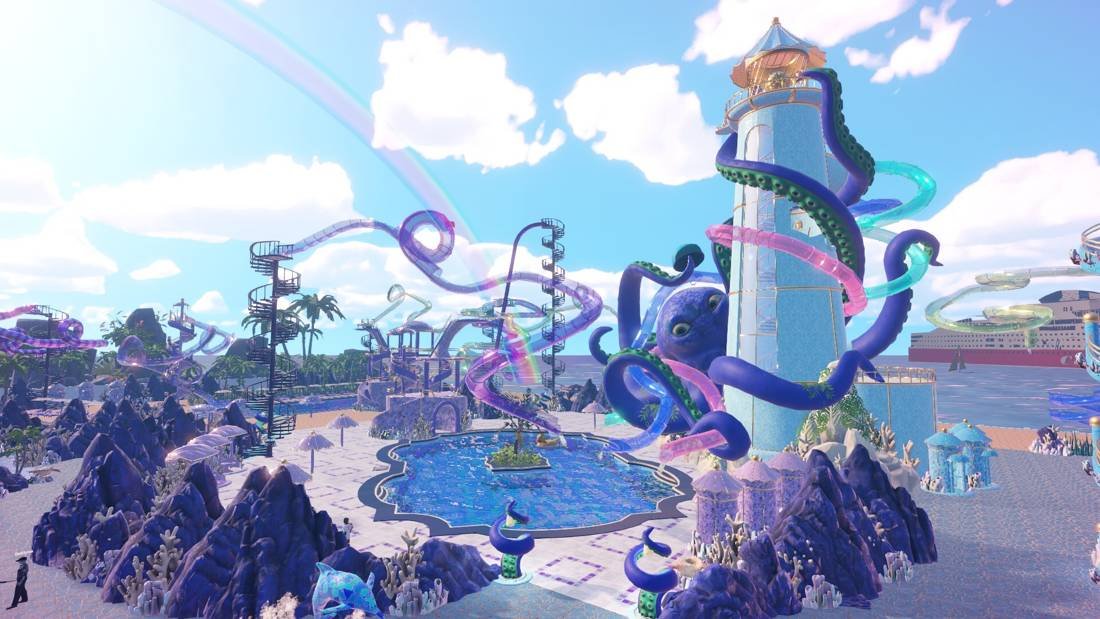
Screenshots and artwork are promotional images from the Waterpark Simulator Steam store page and belong to CayPlay.
More PC game guides to compare with.
Not sure about Waterpark Simulator? Compare it with these games, picked for similar demand and overlapping genres, each with its own full guide.
Steam user reviews put Waterpark Simulator at Overwhelmingly Positive (96% positive from 10,175 reviews, checked 2026-11-02). It is a measure of popularity and sentiment, not of technical performance.
Waterpark Simulator has been out for about 4 months, which means drivers and patches are likely still changing its performance. Re-check settings after major updates.
Details here come from Steam's public store listing. We have not tested the game on every card, so frame rates on this page are estimates from our model.
A short, honest note on how the numbers are produced.
The inputs for Waterpark Simulator are a graphics demand of 23 (taken from the recommended card), a processor score of 21 (from the listed processor line) and 4 GB of VRAM at 1080p High (estimated from the demand score).
Each card is scored against the game demand, then scaled for resolution, quality preset and upscaling. If a card has less VRAM than the game wants, the estimate drops, and a processor ceiling stops frame rates running away.
Please read the figures as estimates rather than measurements. Drivers, game updates, temperatures and the part of the game you are playing can all move them.
Quick answers about Waterpark Simulator requirements, graphics cards, memory and settings.
On the Steam page the entry card is NVidia GeForce GTX 1050 or AMD Radeon RX 570 or equivalent and the recommended card is NVidia GeForce GTX 1070 or AMD Radeon RX Vega 56 or equivalent, with Intel Core i5-6400 as the processor and RAM of 8 GB RAM at minimum (8 GB RAM recommended). Storage needed is 20 GB available space.
The quickest route is the can my PC run it checker. As a rule of thumb, the GTX 1660 Super is the first card we tested that holds 60 FPS at 1080p on High.
For 60 FPS at 1080p on High you want at least the GTX 1660 Super. Among RTX 50 cards the RTX 5050 is the first to clear it.
For a smooth 1440p you want the RTX 2060 at minimum, and among RTX 50 cards the RTX 5050 is the first that gets there.
The model gives 113 FPS at 1080p and 73 FPS at 1440p on High. Its 12 GB of VRAM is comfortable at 1440p here, which means you can usually raise the settings.
By our estimates it manages about 173 FPS at 1440p on High, and roughly 259 FPS with Quality upscaling. Real results vary with drivers, the scene and your processor.
For 4K you want a high-end card with upscaling. By our estimates the RTX 5050 is the first desktop RTX 50 card to hit 60 FPS at 4K on High with Quality upscaling.
Memory use comes out at roughly 4 GB (1080p), 5.2 GB (1440p) and 7.2 GB (4K) on High, which makes 8GB fine at 1080p and fine at 1440p. Leave some spare capacity.
Our estimate is 4 GB at 1080p, 5.2 GB at 1440p and 7.2 GB at 4K on the High preset. That is derived from the publisher recommended specs, so it is a guide rather than a measurement.
The recommended processor is Intel Core i5-6400 and lists Intel Core i5-3550 as the minimum. In the model, Core i3-12100F, Ryzen 5 3600, Core i5-12400F, Ryzen 5 5600 and faster keep a graphics card fed above 60 FPS in this game.
RAM is 8 GB RAM at minimum and 8 GB RAM recommended. Once the operating system and background apps are counted, 16 GB is a sensible target.
Plan for 20 GB available space of free space. No SSD requirement is listed, though faster storage still helps loading.
At typical wattage, RTX 5050 Laptop, RTX 5060 Laptop, RTX 5070 Laptop, RTX 5070 Ti Laptop, RTX 5080 Laptop, RTX 5090 Laptop reach 60 FPS at 1080p on High in our model. Power limit and cooling decide how close a real laptop gets.
Try High with the best upscaler in the menu, then reduce shadows and volumetrics if you need more frames. Use the settings table as a first guess for your card.
We score it 23 on our demand scale, harder to run than 68% of the 937 games we model, which we call moderately demanding. Its CPU score of 21 is above 21% of the games we model.
For multiplayer, a consistent frame rate usually matters more than visual extras. Pick a preset that holds your monitor refresh rate, using the verdict and settings tables as a guide.
Test your own GPU, CPU and settings in this game
Get the best preset for your target FPS
Check this game against your VRAM
See what each upscaling mode gains
Set two or three cards head to head
Find out if your CPU holds you back
Independent site. Not affiliated with or endorsed by CayPlay, CayPlay, Valve, NVIDIA, AMD or Intel. Game names, images and trademarks belong to their owners. Frame rates, VRAM and CPU figures are estimates from our model, not benchmarks.