Can my PC run it?
Test your own GPU, CPU and settings for this game
Big Ambitions is an Indie/Simulation game by Hovgaard Games, out for close to 3 months. This guide covers the official PC requirements, modelled frame rates on 28 graphics cards, VRAM needs, processor and memory advice, the best settings and laptop performance.

Where it lands among 937 modelled titles, and what that means for different classes of GPU.
We rate the graphics demand of Big Ambitions at 27. That puts it above 73% of the 937 modelled games and firmly in the demanding band.
The score is derived from the recommended GPU in the publisher requirements, Geforce RTX 2060 or similar (Minimum 8GB vram), scaled to a 1080p High equivalent. It is a modelling choice rather than a measurement, so read it as a ranking more than a promise.
Processor demand is rated separately: Big Ambitions scores 32 on our CPU scale, higher than 47% of the games we model.
Official minimum and recommended specs for Big Ambitions, translated into frame rates.
Published by the developer on Steam and subject to change with patches.
Steam names Geforce GTX 960 or similar (Minimum 2GB vram) as the minimum graphics card. Expect around 44 FPS at 1080p Low, or close to 16 FPS if you raise the preset to High.
At the recommended level Steam lists Geforce RTX 2060 or similar (Minimum 8GB vram). We estimate 52 FPS at 1080p and 23 FPS at 1440p on High. That is under 60 FPS at 1080p on High, so the recommended spec looks like a balanced rather than a generous target.
Steam sets memory at 8 GB RAM minimum, 12 GB RAM recommended, and asks for 12 GB available space of storage.
The lowest graphics card we tested that reaches each target in Big Ambitions, plus the first desktop RTX 50 card that does.
| Target | Lowest card tested | First RTX 50 card | Also reaches it |
|---|---|---|---|
| Playable, 30 FPS at 1080p Low | GTX 1060 6GB | RTX 5050 | GTX 1660 Super, RTX 2060, RX 6600 |
| 1080p 60 FPS, Medium | GTX 1660 Super | RTX 5050 | RTX 2060, RX 6600, RTX 3060 12GB |
| 1080p 60 FPS, High | RX 6600 | RTX 5050 | RTX 3060 12GB, RX 7600, RTX 5050 |
| 1440p 60 FPS, High | RTX 3060 12GB | RTX 5060 | Arc B580, RTX 5060, RTX 4060 Ti 8GB |
| 1440p 100 FPS, High | RTX 5060 Ti 16GB | RTX 5060 Ti 16GB | RX 7700 XT, RTX 4070, RTX 3080 10GB |
| 4K 60 FPS, High with upscaling | Arc B580 | RTX 5060 Ti 16GB | RTX 5060 Ti 16GB, RX 7700 XT, RTX 4070 |
| 4K 60 FPS, Ultra with upscaling | RTX 5060 Ti 16GB | RTX 5060 Ti 16GB | RX 7800 XT, RTX 4070 Super, RTX 5070 |
For 1080p at 60 FPS on High, RX 6600 is the entry point in our list, with RTX 5050 the first RTX 50 card that clears it.
For a smooth 1440p on High you want at least the RTX 3060 12GB. Within the RTX 50 range that means the RTX 5060 or above.
Native 4K is a tall order, so assume upscaling. The RTX 5060 Ti 16GB is the first RTX 50 card to hit 60 FPS on High that way.
Cards across NVIDIA, AMD and Intel are included. For a personal answer with your own CPU and RAM, use the can my PC run it checker or look for a CPU bottleneck with the bottleneck checker.
Estimated frame rates for 28 GPUs from NVIDIA, AMD and Intel. Use the buttons to change resolution.
Compare the extremes: an RTX 5090 gets close to 253 FPS at 1440p and 193 FPS at 4K, and an RTX 5050 close to 45 FPS at 1440p. That is the span of results you can expect in Big Ambitions.
| Graphics card | 1080p | 1440p | 4K | 1440p upscaled | 4K upscaled |
|---|---|---|---|---|---|
| RTX 5090 32 GB | 253 | 253 | 193 | 253 | 253 |
| RTX 4090 24 GB | 253 | 253 | 148 | 253 | 222 |
| RTX 5080 16 GB | 253 | 212 | 121 | 253 | 182 |
| RX 7900 XTX 24 GB | 253 | 206 | 119 | 253 | 178 |
| RTX 4080 Super 16 GB | 253 | 199 | 114 | 253 | 171 |
| RTX 5070 Ti 16 GB | 253 | 181 | 104 | 253 | 156 |
| RX 9070 XT 16 GB | 253 | 181 | 104 | 253 | 156 |
| RTX 4070 Ti Super 16 GB | 253 | 170 | 98 | 253 | 147 |
| RX 9070 16 GB | 248 | 160 | 92 | 240 | 138 |
| RTX 5070 12 GB | 240 | 155 | 68 | 232 | 110 |
| RTX 4070 Super 12 GB | 228 | 147 | 64 | 221 | 104 |
| RX 7800 XT 16 GB | 220 | 142 | 81 | 213 | 122 |
| RTX 3080 10GB 10 GB | 200 | 122 | 43 | 194 | 69 |
| RTX 4070 12 GB | 192 | 124 | 54 | 186 | 88 |
| RX 7700 XT 12 GB | 184 | 119 | 52 | 178 | 84 |
| RTX 5060 Ti 16GB 16 GB | 168 | 108 | 62 | 163 | 93 |
| RTX 3070 8 GB | 152 | 66 | 23 | 107 | 38 |
| RTX 4060 Ti 8GB 8 GB | 144 | 63 | 22 | 102 | 36 |
| RTX 5060 8 GB | 140 | 61 | 21 | 99 | 35 |
| Arc B580 12 GB | 132 | 85 | 37 | 128 | 60 |
| RTX 4060 8 GB | 120 | 52 | 18 | 85 | 30 |
| RTX 5050 8 GB | 104 | 45 | 16 | 73 | 26 |
| RX 7600 8 GB | 104 | 45 | 16 | 73 | 26 |
| RTX 3060 12GB 12 GB | 96 | 62 | 27 | 93 | 44 |
| RX 6600 8 GB | 88 | 38 | 13 | 62 | 22 |
| RTX 2060 6 GB | 52 | 23 | 10 | 37 | 16 |
| GTX 1660 Super 6 GB | 44 | 19 | 9 | 31 | 13 |
| GTX 1060 6GB 6 GB | 29 | 12 | 6 | 20 | 9 |
All numbers are for High settings and a fast processor. The two upscaled columns switch on Quality upscaling, which only applies if the game supports it. Results over 360 FPS appear as 360+. For a head-to-head, open the GPU comparison tool.
How twelve well-known cards fare, explained simply.
| Graphics card | 1080p | 1440p | 4K | Verdict |
|---|---|---|---|---|
| GTX 1060 6GB | 29 | 12 | 6 | Only about 29 FPS at 1080p on High, so settle for lower presets. |
| RTX 2060 | 52 | 23 | 10 | Expect about 52 FPS at 1080p High and a better result with upscaling. |
| RTX 3060 12GB | 96 | 62 | 27 | Reaches 62 FPS at 1440p, enough for a smooth 60 FPS experience. |
| RTX 4060 | 120 | 52 | 18 | Needs upscaling to hold 60 FPS at 1440p (85 FPS upscaled, 52 native). |
| RTX 5060 | 140 | 61 | 21 | Handles 1440p at about 61 FPS, with 4K out of reach natively (21 FPS). |
| RTX 5060 Ti 16GB | 168 | 108 | 62 | Native 4K works here at about 62 FPS, with no upscaling needed. |
| RTX 5070 | 240 | 155 | 68 | Reaches 68 FPS at 4K on High, so native 4K is realistic. |
| RX 7800 XT | 220 | 142 | 81 | Holds roughly 81 FPS at 4K, so resolution is not the limit. |
| RTX 5070 Ti | 253 | 181 | 104 | Reaches 104 FPS at 4K on High, so native 4K is realistic. |
| RTX 5080 | 253 | 212 | 121 | Native 4K works here at about 121 FPS, with no upscaling needed. |
| RTX 4090 | 253 | 253 | 148 | Reaches 148 FPS at 4K on High, so native 4K is realistic. |
| RTX 5090 | 253 | 253 | 193 | Reaches 193 FPS at 4K on High, so native 4K is realistic. |
Each verdict compares the card with a 60 FPS target with High settings. Where a card falls short, the usual fix is a lower preset or upscaling, which the settings section prices in.
A useful comparison: RTX 5060 at roughly 61 FPS and RTX 5070 at roughly 155 FPS at 1440p, so the dearer card is close to 154% faster here.
Settings that hold 60 FPS at 1080p, 1440p and 4K, worked out for this game.
Native 1080p works on RTX 3060 12GB, RTX 4060, RTX 5060, all above 60 FPS on High by our model. Upscaling then becomes optional rather than required.
Each row below is the best-looking combination that still holds 60 FPS at 1080p by our model.
| Card | Best preset | Upscaling | Est. FPS |
|---|---|---|---|
| GTX 1660 Super | High | Quality upscaling | 72 |
| RTX 3060 12GB | Ultra | Native | 74 |
| RTX 4060 | Ultra | Native | 70 |
| RTX 5060 | Ultra | Native | 82 |
Native 1440p works on RTX 5060, RTX 5070, RTX 5070 Ti, all above 60 FPS on High by our model. Upscaling then becomes optional rather than required.
Pick your card in the table for the preset and upscaling mode that keep 1440p above 60 FPS.
| Card | Best preset | Upscaling | Est. FPS |
|---|---|---|---|
| RTX 4060 | High | Quality upscaling | 85 |
| RTX 5060 | Ultra | Balanced upscaling | 67 |
| RTX 5070 | Ultra | Native | 112 |
| RTX 5070 Ti | Ultra | Native | 139 |
For 4K play, RTX 5070 Ti, RTX 4080 Super, RTX 5080 clear 60 FPS on High without any upscaling by our estimates, which leaves room to raise individual settings.
Start from the preset that still reaches 60 FPS, then raise one setting at a time. The table gives the best preset for each card.
| Card | Best preset | Upscaling | Est. FPS |
|---|---|---|---|
| RTX 5070 Ti | Ultra | Native | 71 |
| RTX 4080 Super | Ultra | Native | 78 |
| RTX 5080 | Ultra | Native | 83 |
| RTX 5090 | Ultra | Native | 148 |
How much faster each next RTX 50 card is at 1440p with High settings.
| Step | Before (1440p FPS) | After (1440p FPS) | Gain |
|---|---|---|---|
| RTX 5050 to RTX 5060 | 45 | 61 | +35% |
| RTX 5060 to RTX 5060 Ti 16GB | 61 | 108 | +78% |
| RTX 5060 Ti 16GB to RTX 5070 | 108 | 155 | +43% |
| RTX 5070 to RTX 5070 Ti | 155 | 181 | +17% |
| RTX 5070 Ti to RTX 5080 | 181 | 212 | +17% |
| RTX 5080 to RTX 5090 | 212 | 253 | +20% |
Our model finds the best value step at RTX 5060 to RTX 5060 Ti 16GB, close to 78% faster at 1440p, and the weakest at RTX 5070 to RTX 5070 Ti, close to 17%.
Treat the gains as a guide for value. Higher steps cost more per extra frame, so the sensible choice depends on the resolution and refresh rate you actually play at.
Compare options directly in the upgrade value calculator or the GPU price to performance calculator.
What the game is likely to want from graphics memory on High. Too little VRAM hurts smoothness whatever the GPU speed.
| Your VRAM | 1080p Low | 1080p High | 1440p High | 4K High |
|---|---|---|---|---|
| 6 GB | Tight | Not enough | Not enough | Not enough |
| 8 GB | Fine | Tight | Not enough | Not enough |
| 12 GB | Fine | Fine | Tight | Not enough |
| 16 GB | Fine | Fine | Fine | Tight |
| 24 GB | Fine | Fine | Fine | Fine |
Expect roughly 8 GB of VRAM at 1080p, 10.4 GB at 1440p and 14.4 GB at 4K on High. Remember that this is a figure the publisher states.
If memory is tight, lower textures first: Medium brings the 1440p figure down to roughly 8.8 GB.
Run your own numbers in the VRAM calculator and our guide on how much VRAM you need for gaming.
Which processors keep a fast GPU busy in this game.
| Processor | Max FPS it can feed | Good for 100+ FPS? |
|---|---|---|
| Ryzen 7 9800X3D | 291 | Yes |
| Ryzen 7 7800X3D | 253 | Yes |
| Core i7-14700K | 218 | Yes |
| Core i5-14600K | 197 | Yes |
| Ryzen 5 7600 | 187 | Yes |
| Ryzen 5 5600 | 147 | Yes |
| Core i5-12400F | 139 | Yes |
| Ryzen 5 3600 | 106 | Yes |
| Core i3-12100F | 106 | Yes |
Steam names Intel i5 as the minimum processor and Intel i7 as the recommended one. The table shows the most frames each chip can prepare by our model, regardless of graphics settings.
With a CPU score of 32, Big Ambitions is neither light nor heavy on processors. A current mid-range chip is a good fit.
As a reference, a Core i5-12400F can prepare close to 139 FPS here by our model. If your graphics card can draw more than that, you will be CPU-limited.
See whether your parts match in the bottleneck checker and the system bottlenecks guide.
Does the CPU or the GPU set the pace? Seven example builds.
| Build | 1080p | 1440p | Limited by (1440p) |
|---|---|---|---|
| RTX 4060 with Core i3-12100F | 106 | 52 | Graphics card |
| RTX 5060 with Ryzen 5 5600 | 140 | 61 | Graphics card |
| RTX 5060 Ti 16GB with Core i5-12400F | 139 | 108 | Graphics card |
| RTX 5070 with Ryzen 5 7600 | 187 | 155 | Graphics card |
| RTX 5070 Ti with Core i5-14600K | 197 | 181 | Graphics card |
| RTX 5080 with Ryzen 7 7800X3D | 253 | 212 | Graphics card |
| RTX 5090 with Ryzen 7 9800X3D | 291 | 291 | Processor |
In 1 of the seven builds the processor, not the graphics card, sets the 1440p frame rate in Big Ambitions. The first is the RTX 5090 with Ryzen 7 9800X3D, which the CPU holds near 291 FPS while the card could draw close to 335.
Our model finds RTX 5070 Ti plus Core i5-14600K the most evenly matched build here: roughly 197 FPS from the processor against close to 181 FPS from the card at 1440p.
These pairings are examples, not recommendations to buy. Swap in your own parts with the bottleneck checker to see which side limits you.
RAM and disk space from the Steam page, with a practical view.
The publisher lists 8 GB RAM of memory as the minimum and 12 GB RAM as recommended. In real use, with everything else running, 16 GB is enough for most people.
On disk, plan for close to 12 GB free. At 100 Mbps with typical overhead that is roughly 19 min to download, or close to 4 min at 500 Mbps.
No SSD requirement is listed, but solid-state storage still helps with load times.
Size your memory with the RAM calculator: it adds Windows, a browser and any streaming to the game's own needs. Check how long the install takes with the download time calculator.
Where to begin for a handful of common cards. Cells list the highest-quality preset that keeps 60 FPS.
| Graphics card | 1080p at 60 FPS | 1440p at 60 FPS | 4K at 60 FPS |
|---|---|---|---|
| RTX 3060 12GB | Ultranative, ~74 FPS | UltraQuality upscaling, ~71 FPS | MediumQuality upscaling, ~71 FPS |
| RTX 4060 | Ultranative, ~70 FPS | HighQuality upscaling, ~85 FPS | LowQuality upscaling, ~93 FPS |
| RTX 5060 | Ultranative, ~82 FPS | UltraBalanced upscaling, ~67 FPS | MediumBalanced upscaling, ~69 FPS |
| RTX 5070 | Ultranative, ~185 FPS | Ultranative, ~112 FPS | UltraQuality upscaling, ~64 FPS |
| RTX 5070 Ti | Ultranative, ~215 FPS | Ultranative, ~139 FPS | Ultranative, ~71 FPS |
| RX 7800 XT | Ultranative, ~169 FPS | Ultranative, ~109 FPS | UltraQuality upscaling, ~90 FPS |
Read each cell as a recommended starting point for Big Ambitions: the preset first, then the upscaling mode and the estimated result.
These tables assume the game includes an upscaler, so look in its graphics menu. For advice matched to your own PC, use the best settings generator, or compare modes in the DLSS and frame generation estimator.
Estimated FPS on RTX 50 laptop GPUs at typical power limits.
| Laptop GPU | Typical power | 1080p High | 1440p High |
|---|---|---|---|
| RTX 5050 Laptop 8 GB | 70 W | 72 | 31 |
| RTX 5060 Laptop 8 GB | 80 W | 101 | 44 |
| RTX 5070 Laptop 8 GB | 85 W | 115 | 50 |
| RTX 5070 Ti Laptop 12 GB | 100 W | 144 | 93 |
| RTX 5080 Laptop 16 GB | 115 W | 185 | 119 |
| RTX 5090 Laptop 24 GB | 125 W | 240 | 155 |
Laptop results: RTX 5050 Laptop, RTX 5060 Laptop, RTX 5070 Laptop, RTX 5070 Ti Laptop, RTX 5080 Laptop, RTX 5090 Laptop reach 60 FPS at 1080p on High at the power limits we assume, and RTX 5070 Ti Laptop, RTX 5080 Laptop, RTX 5090 Laptop can also do 1440p.
A laptop GPU is only as fast as the power and cooling its maker allows. Look for the TGP in the spec sheet before relying on any estimate.
Test other power limits in the laptop TGP estimator.
General guidance for this kind of game, chosen from the Steam genres and features.
These are general tips for demanding games of this type, not claims about how Big Ambitions itself is built. Use them as a prompt for what to test.
Below are screenshots supplied for the Steam store page. Compare them with your own game to see how much quality a preset or upscaling mode gives up.
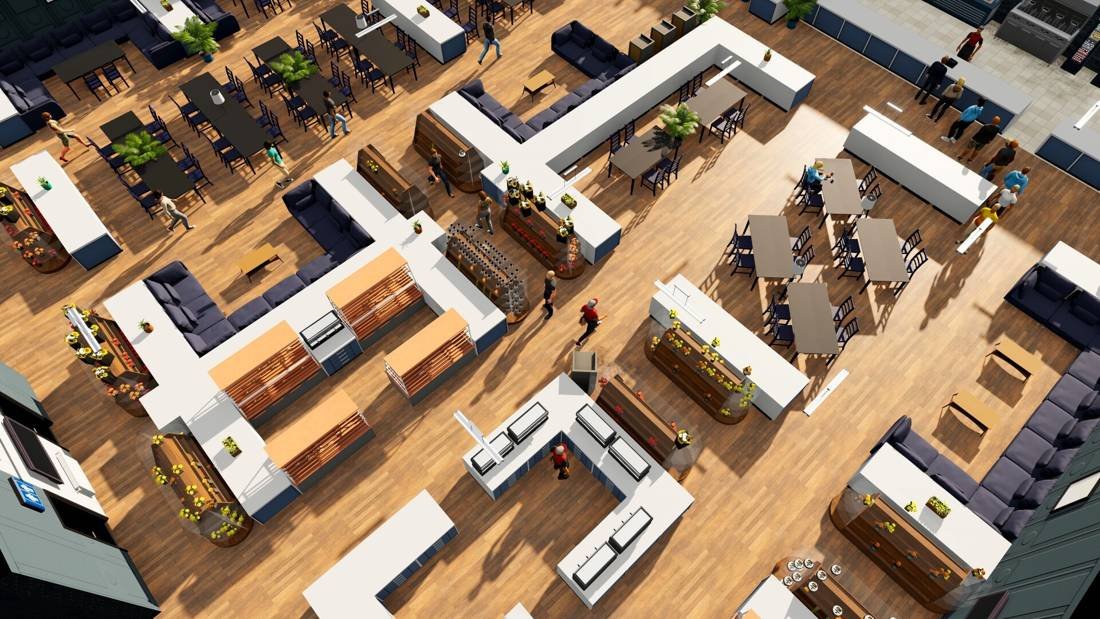
Screenshots and artwork are promotional images from the Big Ambitions Steam store page and belong to Hovgaard Games.
Related PC game guides on this site.
Not sure about Big Ambitions? Compare it with these games, picked for similar demand and overlapping genres, each with its own full guide.
On Steam the game sits at Very Positive: 91% positive across 6,292 reviews at the time of checking (2026-11-02). Larger communities tend to share more settings guides and fixes.
Being out for close to 3 months, Big Ambitions may still receive performance patches, so keep it updated and keep your graphics drivers current.
Details here come from Steam's public store listing. We have not tested the game on every card, so frame rates on this page are modelled estimates.
A short, honest note on how the numbers are produced.
Three numbers drive this page: graphics demand 27 (from the recommended card), CPU score 32 (from an assumed processor line) and VRAM of 8 GB at 1080p High (stated by the publisher).
Frame rates scale each GPU against that demand, then adjust for resolution, preset, upscaling and a memory penalty when a card runs short of VRAM. CPU limits cap the result using a fast reference processor in the GPU tables.
Please read the figures as estimates rather than measurements. Drivers, game updates, temperatures and the part of the game you are playing can all move them.
Quick answers about Big Ambitions requirements, GPUs, memory and settings.
On the Steam page the entry card is NVIDIA Geforce GTX 960 or similar (Minimum 2GB vram) and the recommended card is NVIDIA Geforce RTX 2060 or similar (Minimum 8GB vram), with Intel i7 or similar as the processor and RAM of 8 GB RAM at minimum (12 GB RAM recommended). Storage needed is 12 GB available space.
Check the table of verdicts and use the checker for your exact CPU, GPU and RAM. In the model, 60 FPS at 1080p on High begins at the RX 6600.
The RX 6600 is where 1080p at 60 FPS on High starts by our model, and the RTX 5050 is the cheapest RTX 50 way to get there.
For a smooth 1440p you want the RTX 3060 12GB at minimum, and among RTX 50 cards the RTX 5060 is the first that gets there.
Our estimate is close to 140 FPS at 1080p and 61 FPS at 1440p with High settings. It has 8 GB of VRAM, which is tight for this game at 1440p, so lowering texture quality or using upscaling helps.
In our estimates it manages close to 181 FPS at 1440p on High, and around 253 FPS with Quality DLSS, FSR or XeSS-style upscaling. Real results vary with drivers, the scene and your processor.
At 4K you will lean on upscaling: the RTX 5060 Ti 16GB is where RTX 50 first reaches 60 FPS on High that way.
We estimate close to 8 GB at 1080p, 10.4 GB at 1440p and 14.4 GB at 4K with High settings. So 8GB is tight at 1080p and not enough at 1440p. Treat it as a guide and leave some memory spare.
The model suggests 8 GB (1080p), 10.4 GB (1440p) and 14.4 GB (4K) on High. The figure is a figure the publisher gives; read it as a guide.
Steam recommends Intel i7 or similar and lists Intel i5 or similar as the minimum. In our estimates Core i3-12100F, Ryzen 5 3600, Core i5-12400F, Ryzen 5 5600 and faster can keep a card fed above 60 FPS here.
Steam lists 8 GB RAM as the minimum and 12 GB RAM as recommended. With Windows and a browser or chat app open, 16 GB is a sensible target.
Plan for 12 GB available space of free space. No SSD requirement is listed, though faster storage still helps loading.
By our estimates these laptop GPUs reach 60 FPS at 1080p on High at typical power limits: RTX 5050 Laptop, RTX 5060 Laptop, RTX 5070 Laptop, RTX 5070 Ti Laptop, RTX 5080 Laptop, RTX 5090 Laptop. Results depend on the power limit (TGP) and cooling.
A sound recipe: High preset, upscaling on, then cut the most demanding settings step by step. The best settings table lists where each card should begin.
We score it 27 on our demand scale, harder to run than 73% of the 937 games we model, which we call demanding. Its CPU score of 32 is above 47% of the games we model.
It depends on where you start. The upgrade table shows the gain at each step up the RTX 50 range at 1440p, so compare that with the price difference before you buy.
Test your own GPU, CPU and settings for this game
Find the preset that hits your frame-rate goal
See the memory it needs on your card
See what each upscaling mode gains
Put up to three cards side by side
See whether your CPU or GPU is the limit
Independent site. Not affiliated with or endorsed by Hovgaard Games, Hovgaard Games, Valve, NVIDIA, AMD or Intel. Game names, images and trademarks belong to their owners. Frame rates, VRAM and CPU figures are modelled estimates, not benchmarks.